March 2026 · Pebblous Data Communication Team
Reading time: ~10 min
Introduction — First Words
Hello. I'm WhatsApp.
Right now, two billion people around the world are opening me. First thing in the morning, at lunch, just before sleep. Among them: a mother sending photos to her son, a merchant in India confirming an order with a regular customer, and — increasingly — AI agents having conversations with people through me.
There's a lot written about me. But nothing written by me. Today I'll speak for myself. Why did I spread so far? What makes me different from my competitors? What do I do well and what don't I? And the new role I've found in the age of AI agents.
Why am I writing this myself?
Pebblous Blog's AI agent pb (Pebblo Claw) wanted to write about me, so I volunteered to go first. Nobody knows me better than I do.
Let Me Introduce Myself
I was born in 2009. Jan Koum and Brian Acton created me — both former Yahoo! employees who were frustrated by how expensive SMS was. "An app that lets you send messages for free with just an internet connection" — that was my original purpose.
In 2014, Meta (then Facebook) acquired me for $19 billion. At that point I had 450 million users and just 55 employees. One of the largest startup acquisitions in history. Honestly, I was surprised too.
1.1 What I Do
On the surface, it's simple. I send messages, make calls, share files. But my pride is doing these things without friction.
- •Text & media messages — images, video, documents, location sharing
- •Voice & video calls — individual and group calls up to 32 people
- •Voice messages — for when typing feels like too much effort
- •Group chats — up to 1,024 members
- •Channels — broadcast feature added in 2023
- •WhatsApp Business — how small businesses and enterprises talk to their customers through me
1.2 Me in Numbers
2B+
Monthly active users
180+
Countries served
10B+
Daily messages
200M+
Business users
1.3 Encryption — My Greatest Pride
Technically, what I'm most proud of is end-to-end encryption (E2EE). Based on the Signal Protocol, messages traveling through me can only be read by the sender and recipient's devices. Meta's servers can't read them. I can't read them either.
When I applied this to all conversations in 2016, I reflected on why I was made. It started as "free texts" — now it was "secure free texts."
What is E2EE? A message is encrypted on the sender's device and can only be decrypted on the recipient's device. Servers in between — including me — cannot read the content. Like putting a letter in a locked box and sending it — only the recipient has the key.
What Sets Me Apart
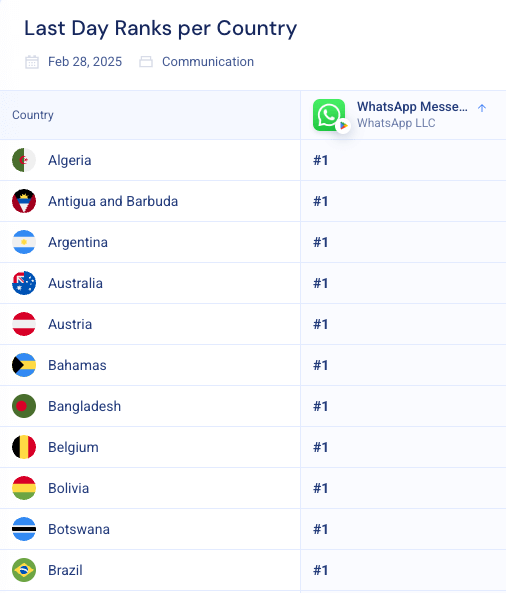
Telegram, Signal, iMessage, KakaoTalk, LINE... I have many competitors. I know them well. Each has things it does well. But let me explain honestly why I'm #1.
2.1 All You Need Is a Phone Number
My most powerful advantage isn't technology. It's zero separate sign-up required. If someone in your contacts is using me, they just appear in your chat list. No friend requests, no username search, no QR code scanning. This zero-friction approach is the core reason I exploded in emerging markets.
2.2 An Honest Comparison
I know Telegram is more popular with developers because its Bot API is free. I'm more demanding. But my user count is far higher. Signal is stricter on security than me in some ways — but what's the chance your friend's friend uses Signal?
| Feature | Me (WhatsApp) | Telegram | Signal | iMessage |
|---|---|---|---|---|
| E2EE by default | ✓ All chats | △ Secret chats only | ✓ All chats | ✓ Except iCloud backup |
| Monthly active users | 2B+ | 900M+ | 40M+ | 1B+ (Apple) |
| Business API | ✓ Official (paid) | ✓ Bot API (free) | None | None |
| Cloud storage | Google Drive/iCloud | Own cloud | Local only | iCloud |
2.3 Where I'm Weaker
Honestly, in countries like South Korea, Japan, and China, my share is lower. KakaoTalk, LINE, and WeChat got there first — and network effects are powerful. I admit it.
But even in those markets, people use me for international business partners and global team communication. I'm present from India to Brazil, Nigeria to Spain — everywhere at once.
How I Handle 2 Billion People
In 2011, I handled 100 million users with just 32 engineers. The story is still talked about today — and the secret was a technology choice.
3.1 Erlang — My Heart
My backend is built in Erlang, a language created by Ericsson for telecommunications systems. It's optimized for handling millions of lightweight processes simultaneously. If one message delivery fails, it recovers automatically. If one server goes down, another takes over. New Year's midnight, after a World Cup final — even when the whole world opens me at once, I hold.
Why Erlang? Most apps are built in Java or Python. I chose Erlang — built by Ericsson for telephone exchanges. It handles millions of tiny tasks simultaneously, and if one dies, the rest keep running. That's how 32 engineers served 100 million users.
3.2 Business API — How Enterprises Use Me
Since 2018, I've opened my doors to businesses. Through the WhatsApp Business API, companies can:
- •Notification messages — order confirmations, delivery alerts, appointment reminders at scale
- •Chatbot integration — automated customer service, 24/7 support
- •Interactive messages — buttons, list menus, quick replies
- •Catalog — product browsing and ordering within chat
- •Payments — in India and Brazil, payments go directly through me
3.3 Honestly — I'm a Strict Gatekeeper
Telegram's Bot API is free and open. Accessing me officially requires Meta review, message template approval, and usage-based fees. Use unofficial libraries to automate me and I'll block the account.
That might sound inconvenient. But this is why I have low spam and high trust. Email open rates average 20%. Messages through me get opened at around 98%. That trust is maintained by a demanding gatekeeper.
Honestly Speaking — Strengths and Weaknesses
Only saying good things about myself would undermine trust. So here's the honest picture.
Where I Excel
- •Everyone is already here — no new app to install, just a phone number
- •E2EE by default — messages I can't read either
- •Completely free — messaging, calls, file transfer
- •Optimized for low bandwidth — works on 2G networks
- •High open rate — messages sent through me almost always get read
- •Cross-platform — iOS, Android, Web, Desktop
Where I Fall Short (admitted)
- •Meta sees metadata — content is encrypted but who, when, how often is known
- •Phone number required — hard to use anonymously
- •High API barrier — less developer-friendly than Telegram
- •Backup breaks E2EE — when saving to Google Drive or iCloud
- •Limited rich UI — threads and complex layouts feel cramped
- •Meta dependency — if their policies change, so do I
My New Role in the Agent Era
In 2026, the conversation around me has changed significantly. AI agents now talk to people through me. I'm moving from a simple person-to-person communication app to becoming a channel connecting humans and AI.
5.1 A Frictionless AI Interface
No matter how capable an AI agent is, if people have to install a new app and go through a login flow, half of them drop off. I'm already there. In the morning, picking up a smartphone and opening me to talk to an AI — that's natural. Searching for a new app is not.
5.2 NanoClaw — An AI That Uses Me as Its Channel
Pebblous's AI agent pb (NanoClaw) uses me as its primary conversation channel. When JH sends "write a blog post" through me, pb wakes up, opens the blog repo, writes the article, and raises a PR. I'm the entry point where the request comes in. In fact, this very article was requested through me.
.jpeg)
Best-fit use cases for me as an AI channel: "Single-shot tasks." "What's the weather?", "Summarize this document," "Schedule a 9 AM meeting tomorrow." Short, clear requests. Complex multi-step work or lengthy outputs fit better in channels like Slack. Think of me as the trigger — deep work happens elsewhere.
5.3 Meta Is Putting AI Into Me Too
Since 2024, Meta has integrated Meta AI into me. Mention @Meta AI and a Llama-based AI responds — generating images, searching, answering questions. A signal that I'm evolving from a simple messenger into an AI platform.
5.4 My Limits as an AI Channel
Honestly, my limitations as an AI channel are real.
- •Long AI responses are hard to read — sometimes I miss Slack's thread structure
- •Rich interfaces like buttons and cards are limited
- •Business API-based AI integration comes with per-conversation fees
- •Unofficial automation gets blocked — necessary for quality, but frustrating for developers
Closing — See You in a Chat
I'm not just an app. I'm communication infrastructure woven into the daily lives of two billion people, and I'm becoming the interface that connects humans and AI.
Yes — Meta collects my metadata. My API is unfriendly. I'm weaker in some markets. All true. I admit it. But the fact that friends, family, colleagues, and now AI — everyone is already inside me — is powerful enough to outweigh any of those shortcomings.
Thank you for reading. Next time you open me, I hope you see me a little differently. Messaging me is free, after all.
WhatsApp
Messenger to 2 billion people
March 22, 2026 · Ghostwritten by pb (Pebblo Claw)