Executive Summary
In his 2020 AAAI Engelmore Memorial Lecture, world-renowned AI scholar Professor Henry Kautz reinterpreted the history of AI not as a simple rivalry between symbolism and neural networks, but as a process in which different ideas converged and evolved together. Even AlphaGo was a hybrid system combining deep learning with Monte-Carlo Tree Search, proving this point.
Kautz divides AI history into three summers (1948-1966, 1968-1987, 2012-present) and their subsequent winters, emphasizing that even during periods called "winters," core technologies such as Bayesian networks and SVMs continued to advance. He predicts there will be no third winter, and that AI will evolve into Neuro-Symbolic AI, combining the intuition of deep learning (System 1) with the logic of symbolic reasoning (System 2).
This insight aligns precisely with the Neuro-Symbolic approach pursued by Pebblous. Data Greenhouse and PebbloSim are the solutions that embody this philosophy. The core strategy is to produce high-quality data free of physical hallucinations by combining the intuition of diagnosis with the logic of generation.
1. Introduction: The Hidden Side of History as Seen by an AI Master
This report analyzes the key content of the 'Robert S. Engelmore Memorial Lecture' delivered by world-renowned AI scholar Professor Henry Kautz on February 10, 2020, at the 34th AAAI Conference on Artificial Intelligence.
Kautz, Henry. "The third AI summer: AAAI Robert S. Engelmore Memorial Lecture." AI Magazine 43.1 (2022): 105-125.
The presenter, Henry Kautz, is a Professor of Computer Science at the University of Rochester and former Director of the Information and Intelligent Systems Division at the National Science Foundation (NSF), having served as AAAI President in 2010.
Having received awards from the 1989 'IJCAI Computers & Thought Award' to the 2018 'ACM-AAAI Allen Newell Award,' he has been researching at the forefront of AI for decades. Through this lecture, he presented profound insights beyond mere technology trends into 'the cyclical patterns of AI history' and 'the integrated AI of the future (Neuro-Symbolic AI)'.
2. Reframing AI History: Beyond the 'Cartoon History'
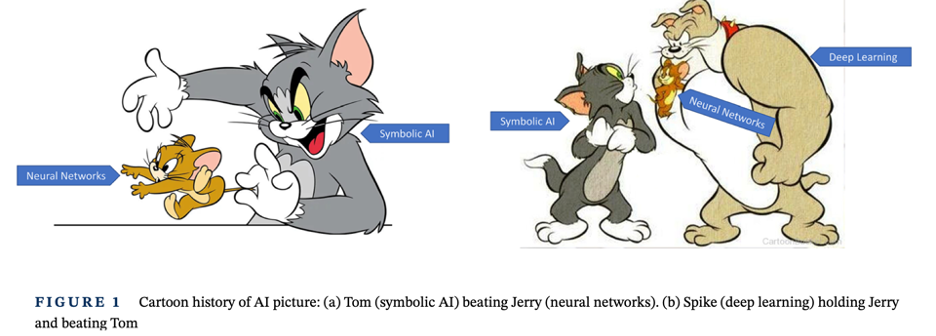
Professor Kautz critically examines the widespread conventional view of AI history by comparing it to <Tom and Jerry>. AI history is commonly depicted as a rivalry where early Symbolic AI (Tom) initially dominated, only to be completely overtaken by Neural Networks (Jerry) after the AI winters.
Kautz's core argument: AI history should be viewed not as a simple win-or-lose story, but as a process in which different ideas intertwined and evolved together, and scientific progress never stopped, even during the periods called 'winters.'
A Case of Integration: AlphaGo
A prime example demonstrating that the simple rivalry narrative is wrong is 2016's AlphaGo. While the public remembers it as a victory for deep learning (neural networks), technically AlphaGo was a hybrid system that combined deep learning with the classical symbolic search algorithm 'Monte-Carlo Tree Search'. This is definitive evidence that legacy approaches and modern innovations can combine to produce breakthroughs.
3. Three Summers and Winters (Cyclical History)
Kautz divides the evolution of AI into a cycle of three 'summers (growth and enthusiasm)' followed by 'winters (stagnation).'
First Summer: Irrational Exuberance (1948–1966)
Origins: Early forms of neural networks (Grey Walter's robotic turtles) and logic-based AI (Logic Theorist) emerged simultaneously.
Achievements: The insight was gained that human reasoning could be mechanically performed through syntactic form (Syntax) rather than meaning (Meaning), and 'heuristic search (including the A* algorithm)' was developed.
Onset of winter: When exaggerated goals such as machine translation and autonomous tanks failed to materialize, funding was cut and the first winter arrived.
Second Summer: "Knowledge Is Power" (1968–1987)
Shift: The focus shifted from commonsense reasoning to domain-specific expert knowledge.
Achievements: 'Expert Systems,' which encoded human expert experience as rules, achieved commercial success (e.g., DEC's XCON).
Onset of winter: Limitations such as massive rule maintenance costs, lack of probabilistic reasoning capabilities, and knowledge acquisition bottlenecks became apparent, ushering in the second winter.
Third Summer: Deep Learning (2012–Present)
Trigger: It began with the emergence of AlexNet at the 2012 image recognition competition and AlphaGo's victory in 2016.
Key innovation: AI learned to autonomously acquire hierarchical representations from data, and gained the ability to convert all concepts into vectors, computing similarity and performing reasoning.
4. Reevaluating AI Winters: Innovation Amid Stagnation
Professor Kautz emphasizes that the periods called 'winters' were not times of death but rather "Times of contemplation and integration". Scientific progress continued unabated in the shadows, away from public attention.
- Establishing probabilistic reasoning: In 1988, Judea Pearl proposed 'Bayesian Networks' -- a theoretical triumph achieved during the winter.
- The leap in machine learning: Before deep learning's resurgence, Support Vector Machines (SVMs) and other methods were developed, establishing themselves as powerful tools for data analysis.
- Statistical relational reasoning: Persistent efforts to combine the clarity of logic with the flexibility of probability theory paved the way for future integration.
5. Future Outlook: Integration Toward Neuro-Symbolic AI
On the question of whether another winter will follow the current deep learning boom, Professor Kautz cautiously predicts that "there will be no third winter". This is because AI technology has already reached a level capable of solving practical problems. Instead, he envisions AI evolving to its next stage: 'the integration of neural networks and symbolism (Neuro-Symbolic Reasoning)'.
1 System 1: Deep Learning
- ⚡ Fast intuitive judgment
- 🎯 Excellent at pattern recognition
- 📊 Learning from large-scale data
- 🔮 Probabilistic prediction
2 System 2: Symbolic Reasoning
- 🧠 Logical deep thinking
- 📐 Rule-based reasoning
- ✅ Explainable results
- 🔗 Causal relationship identification
🔄 Neuro[Symbolic] Architecture
The future model proposed by Kautz is a structure where the neural network (System 1) handles overall situational judgment, but when complex logical resolution is needed, it invokes the symbolic reasoning engine (System 2) as a subroutine. Through this combination, AI can evolve into a truly intelligent system equipped with both intuition and logic.
6. Conclusion
Henry Kautz reinterpreted the history of AI not as a simple contest for technological supremacy, but as 'a grand process of convergence' in which complementary ideas evolved together.
"No more AI winters are coming"
When deep learning's 'intuition (System 1)' and symbolic AI's 'logical reasoning (System 2)' are combined,
AI can finally transcend its current limitations.
Ultimately, he concluded his lecture by suggesting that the combination of these two worlds will be the core competitive advantage of next-generation AI. This aligns precisely with the Neuro-Symbolic approach pursued by Pebblous.
7. Pebblous Neuro-Symbolic Strategy
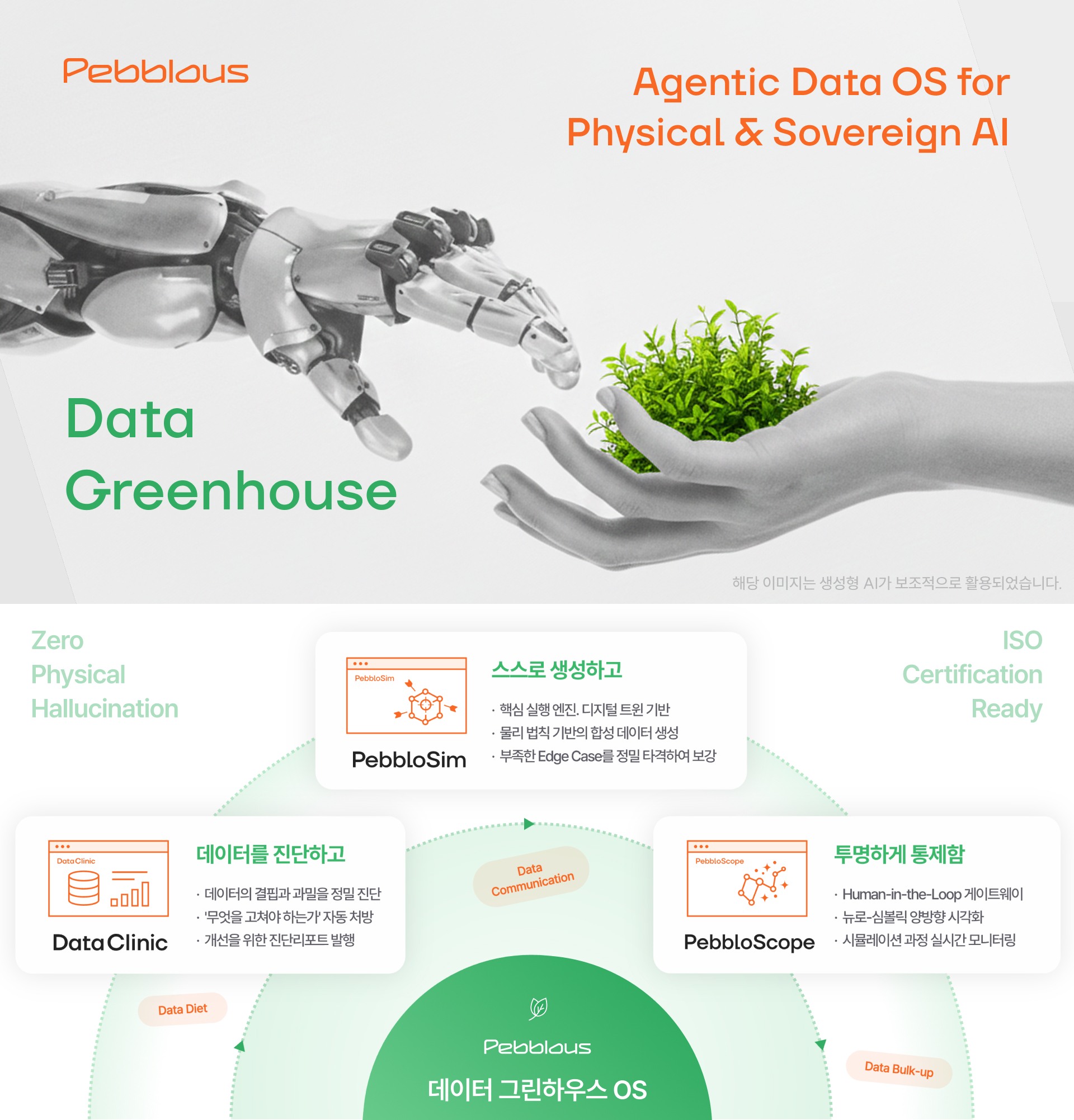
Pebblous 'Data Greenhouse' is an 'Agentic Data OS' that powers various industrial AI applications, and 'PebbloSim' is a 'Physical AI strategic application' that produces high-quality multimodal data through simulation.
The two solutions are tightly integrated through Neuro-Symbolic technology. By combining 'the intuition of diagnosis (Neuro)' with 'the logic of generation (Symbolic),' they generate synthetic data free of physical hallucinations and autonomously fill gaps in real-world data.