Introduction
"Does the flap of a butterfly's wings in Brazil set off a tornado in Texas?"
A while ago a friend's Facebook post caught my eye. It was about chaos theory and the butterfly effect, and as I read it, I realized the idea is more than a piece of physics. The butterfly effect is an epistemological warning that anyone who works with data has to internalize.
The butterfly effect is the phenomenon in which a tiny difference in the initial conditions of a complex system is amplified nonlinearly over time until it produces an entirely different outcome. This piece explores the history of that discovery, the core principles of chaos theory, and its deep connection to data.
A difference in the third decimal place changed the weather two months later
Lorenz's Discovery: One Rounding Error Changed the World
In 1961, MIT meteorologist Edward Lorenz wanted to rerun a weather simulation. To save time, he read a mid-run result off the printout and typed it back in, but instead of the computer's internal precision of 0.506127 he entered the printed 0.506.
The Difference: 0.000127
This tiny difference, less than one part in ten thousand, followed almost the same path at first and then drifted further apart as time went on. Two months into the simulation, the weather pattern was completely different. Lorenz first assumed it was a computer glitch, then realized it was a fundamental property of nature.
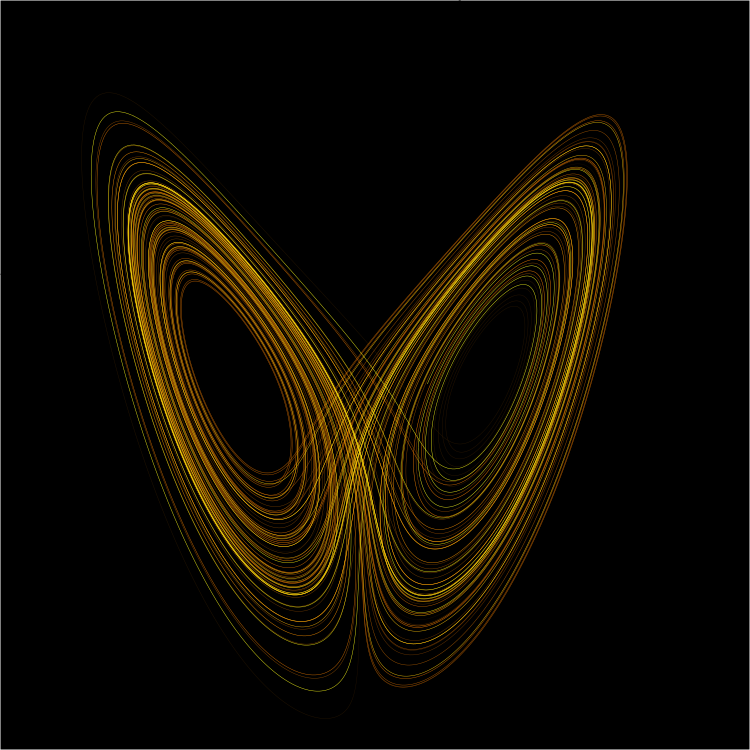
Lorenz published the discovery in 1963 in a paper titled "Deterministic Nonperiodic Flow." Then, in a 1972 talk titled "Does the flap of a butterfly's wings in Brazil set off a tornado in Texas?", he gave the idea the name that carried it into popular culture: the butterfly effect.
Key Insight
What Lorenz found was not merely a weather phenomenon. Even in a deterministic system where the rules are perfectly fixed, long-range prediction is impossible in principle unless you know the initial conditions with infinite precision.
The Three Principles of Chaos Theory
To understand the butterfly effect, you need to see how chaos theory explains complex systems through three core principles.
Deterministic Chaos
Chaotic systems do not run at random. They follow fully deterministic equations, yet their outcomes are unpredictable. That is the central paradox.
A weather system obeys Newtonian mechanics and the laws of thermodynamics exactly. The rules are perfect. But because you can never know the initial state with infinite precision, the system behaves chaotically.
Rules = perfect | Precision of initial conditions = finite | Prediction = impossible
Sensitive Dependence
Even the smallest difference in initial conditions makes the system's trajectory diverge exponentially. The mathematical measure of that divergence is the Lyapunov exponent.
Initial difference
ε = 0.000127
Error after 60 days
≫ unpredictable
Prediction Horizon
Every chaotic system has a temporal limit beyond which reliable prediction is impossible. For weather forecasting, the theoretical limit is roughly two weeks. No matter how much observation equipment and computing power improve, that limit cannot be fundamentally overcome.
To raise a 10-day forecast to the accuracy of a 5-day forecast, you have to improve observation precision tenfold; to reach 14-day accuracy, you need to improve it a hundredfold. That is what exponential amplification means.
The Butterfly Effect in the Real World
The butterfly effect is not an abstract theory. Economics, fluid dynamics, engineering, ecosystems — it operates anywhere a complex system exists.
Economics & Finance
The 2008 financial crisis began with localized defaults in the U.S. subprime mortgage market. The globally connected financial network amplified that shock exponentially and drove the entire world's financial system toward collapse. The 1997 Asian financial crisis was likewise triggered by a single event, the devaluation of the Thai baht.
Fluid Dynamics & Weather
Turbulence is the textbook case of chaos. When a small disturbance appears in laminar flow, the moment the Reynolds number crosses a critical threshold an entirely different flow pattern takes shape. That leaves fundamental uncertainty in aircraft design and engine efficiency calculations.
Engineering & Structures
The 1940 collapse of the Tacoma Narrows Bridge was caused by winds carrying less than 10% of the design load. The interplay between the resonant frequency and chaotic vibration destroyed the structure. It is a classic butterfly effect: a small initial oscillation that led to the collapse of the whole system.
Ecosystems & Evolution
The predator-prey population model (the Lotka-Volterra equations) is deterministic yet exhibits chaotic behavior. A change in one species' population can fundamentally reshape an entire ecosystem decades later. The 1995 reintroduction of wolves to Yellowstone National Park, which changed the course of rivers, is a well-known example.
Philosophical Implications: Precision, Control, Humility
The worldview chaos theory offers goes beyond physics. It is a fundamental epistemology for science, engineering, and decision-making.
Precision Is King
In a chaotic system, measurement precision directly determines how far ahead you can predict. Improve precision tenfold and the predictable window extends by a fixed amount. Data collection, sensor precision, and the accuracy of numerical representation are not mere technical details but core design parameters of any prediction system.
You Must Know the Limits of Control
Chaos theory shows that systems we believed we could predict and control may not actually be that way. Economic policy, climate intervention, ecosystem management — every one of them has a prediction horizon. Refusing to acknowledge that limit is what creates the greater danger.
Humility Before Data
The butterfly effect teaches us to be humble in the face of data. We have to keep asking how precise our data really is, how far ahead we can trust it, and which initial conditions we are missing. That humility is the starting point for better prediction and better decisions.
"Chaos is not the science of unpredictability. It is the science that tells us precisely how far we can predict and where we have to give prediction up."
AI Data and the Butterfly Effect
The butterfly effect does not operate only in weather simulations. An AI model's training pipeline is a stage for chaos theory too.
| Chaos Theory Concept | AI Data Pipeline |
|---|---|
|
Initial conditions The starting state of a weather simulation |
Training dataset The starting point of model training |
|
Rounding 0.506127 to 0.506 A tiny initial error |
Label noise / class imbalance A tiny bias in the training data |
|
Sensitive dependence Exponential amplification of error |
Bias amplified layer by layer Nonlinear amplification in deep learning |
|
Prediction horizon The limit of reliable prediction |
Model confidence range (distribution boundary) Confidence drops sharply outside the data distribution |
An AI model starts from an initial condition: its training data. Any tiny bias or error in that data is amplified nonlinearly as the model grows deeper. Just as Lorenz's rounding of 0.000127 rewrote the weather two months later, a tiny error in the training data steers the model's predictions in an unexpected direction.
And every model has a prediction horizon. The moment an input arrives that falls outside the training data's distribution, the model's confidence collapses. Measuring and documenting that limit precisely is the core value of data quality diagnosis.
DataClinic: A Tool for Diagnosing Initial Conditions
Seen through the lens of the butterfly effect, data quality diagnosis is not simple inspection. It is the work of measuring the initial conditions of an AI prediction system, removing the points of contamination, and defining the range of confidence.
Outlier Detection
Density-based analysis (DataLens) detects anomalous samples in the training data. Like Lorenz's rounding error, it catches the small but fatal points of data contamination before they matter.
Distribution Bias Quantification
It puts numbers on class imbalance and distribution bias. It estimates in advance which class has distorted initial conditions and how much that distortion will affect model performance.
Label Quality Verification
Label noise and annotation inconsistency are the subtlest errors in training data. DataClinic visualizes them and quantifies the contamination rate.
Confidence Range Report
It brings the diagnostic results together to estimate the model's prediction confidence range. Like the butterfly effect's prediction horizon, it spells out how far this model can be trusted.
The Shared Goal of the Butterfly Effect and DataClinic
Just as chaos theory defines the precise limits of weather prediction, DataClinic defines the limits of AI model prediction at the data level. Acknowledging unpredictability and making the trustworthy range explicit — that is the essence of a scientific approach.
Frequently Asked Questions
What is the butterfly effect?
How did Lorenz discover the butterfly effect?
What is deterministic chaos?
What impact does the butterfly effect have on the economy?
What is the prediction horizon?
How does the butterfly effect relate to AI training data?
How does DataClinic address the butterfly-effect problem?
What are the limits of chaos theory, and how controllable are chaotic systems?
Conclusion: Why We Must Be Humble Before Data
Edward Lorenz found a fundamental property of the world in a difference of 0.000127. The AI systems we work with are no different. A tiny bit of contamination in the training data, a little noise in the labels, a subtle bias in the distribution — these are all the flap of a butterfly's wings. We cannot know in advance where that flap will spawn a tornado, but we can measure and record that it exists. In that sense, data quality diagnosis does not sell predictability; it sells trustworthiness.