Executive Summary
This article reads the area scores of the 2025 public data evaluation that Korea's Ministry of the Interior and Safety applied to 684 public bodies. Lee Sang-sik, a member of the National Assembly's Public Administration and Security Committee, released the year-by-year trend of that evaluation at the parliamentary audit on 6 October, and it showed the openness and use score falling for a second year. The other two areas in the same evaluation went up.
The number worth pausing on is 37.8. That is what the 'AI-friendly, high-value data opening' indicator scored in 2025, the year it was added, and that is well below 59.2, the lowest of the three area scores. The explanation the ministry put in its press release is short. The indicator calls for specialist technology such as de-identifying data, and that is why the score came out low. In the same year the management systems area scored 89.5.
The scores and quotations carried in this article come from the evaluation results press release the ministry published on 31 March 2026, from the annex attached to it, and from reporting on the analysis by Lee Sang-sik's office. The indicator-level scores come from charts appended behind that release rather than from its text. The passage at the end of section 2 that weighs what the new indicator did to the area score, and the reading in sections 3 and 5 that treats proving you manage data and proving AI can use it as two different jobs, belong to no party in the story. They are this article's interpretation.
Key numbers
Here are four numbers. The first two are the highest of the three area scores and the score of an item first graded in 2025, and the last two point at what is happening on the opening side.
Sources: Ministry of the Interior and Safety press release (31 March 2026), Dailian (6 October 2026).
89.5
Management systems area score
The highest of the three areas. In 2023 it stood at 59.4
37.8
'AI-friendly, high-value data opening' indicator
Added in 2025, the weakest of the nine indicators outside the bonus item
9.0
Two-year fall in the openness and use score
From 68.2 in 2023 to 59.2 in 2025, down in both years
2,219
File datasets not updated for over a year
More than half of them, 1,129, belong to local governments
The Three Area Scores Are Not the Bottom
The Public Data Provision and Operation Evaluation is run every year by the Ministry of the Interior and Safety and covers central government, local government and public institutions. The 2025 round assessed 684 bodies against ten indicators grouped into three areas: openness and use, quality, and management systems. The results were published on 31 March 2026 alongside a report to the Cabinet.
Seen whole, it was a good year. 348 bodies, 50.9 percent of the total, earned a grade of 'good' or better, up from 36.2 percent in 2023 and 40.9 percent in 2024. Basic local governments climbed a step from 'poor' last year to 'fair' this year.
Break it down by area and the picture changes. Management systems scored 89.5, quality 72.5, and openness and use 59.2, leaving 30.3 points between the highest area and the lowest. In 2025 two new indicators joined the openness and use area. One is 'AI-friendly, high-value data opening', and it scored 37.8. The other, 'provision of pseudonymized data and opening of synthetic data', was attached as a bonus item.
Why the indicator exists is written in the press release. It was brought in and given close attention, the ministry says, to promote the opening of high-quality, high-value public data suited to the age of AI. Taken at its word, this is the box that asks how much data a body has put out in a form AI can pick up and use straight away. The first year came back at 37.8.
In the body of the release the ministry published, exactly one indicator carries a score of its own, and this is it. Turn to the reference material attached to the same release, though, and all ten indicator scores are printed there as bar charts. Management systems breaks down into training participation at 93.8 and implementation base at 83.2. Quality splits into data value management at 76.5, action on diagnostic findings at 71.9, and the quality management system at 68.5. Inside openness and use are user support at 87.3, establishment and delivery of opening plans at 63.1, outcomes of use support at 52.5, and 'AI-friendly, high-value data opening' at 37.8. The bonus item, 'provision of pseudonymized data and opening of synthetic data', came out at 6.4, an average across all 684 bodies, only 62 of which scored on it at all. So nothing among the other nine scored lower than 37.8, and once the bonus is counted in, 6.4 sits below it. Both of those items appeared for the first time in 2025.
The Average Rose, Openness and Use Alone Fell
The material Lee Sang-sik obtained from the ministry and released at the parliamentary audit on 6 October carries the evaluation's year-by-year trend. A direction that a single year's result keeps hidden shows up here.
| Area | 2023 | 2024 | 2025 | Two-year change |
|---|---|---|---|---|
| Openness and use | 68.2 | 60.4 | 59.2 | −9.0 |
| Management systems | 59.4 | Not disclosed | 89.5 | +30.1 |
| Quality | 58.1 | Not disclosed | 72.5 | +14.4 |
| Overall average | 63.1 | Not disclosed | 67.6 | +4.5 |
▲ Area scores by year, obtained from the Ministry of the Interior and Safety and released by Lee Sang-sik's office | Source: Dailian (6 October 2026). For 2024, only the openness and use score was disclosed. The two sources do not place the 63.1 overall average in the same year. Dailian puts it in 2023, while the chart by institution type in the annex to the ministry's press release marks the same 63.1 as the 2024 overall average. The table follows the report's dating rather than choosing between the two.
Management systems gained 30.1 points in two years and quality gained 14.4. The overall average rose 4.5 points, from 63.1 to 67.6. Over the same two years openness and use alone fell from 68.2 to 59.2, a drop of 9.0 points. The force lifting the average and the force pulling the opening score down were at work inside the same evaluation.
One thing has to be read alongside the size of that fall. Of the 9.0 points across the two years, 7.8 came between 2023 and 2024, and the fall between 2024 and 2025 was 1.2 points. And 2025 is the year the 'AI-friendly, high-value data opening' indicator joined the openness and use area. A second indicator arrived in the same year, but it came in as a bonus, and a bonus only adds to a score. The item that can cost the area points is the one worth 37.8. The area score for the year that item arrived and the area score for the year before it are not measured with the same set of indicators. This is this article's reading, and neither the ministry nor Lee Sang-sik's office put it that way.
Turned around, the implication gets sharper. If the ministry's account that this indicator pulled the area score down is taken as it stands, the 2025 openness and use score with that effect set aside would have been higher than 59.2. A new box was drawn on the scorecard, a gap that had gone unmeasured surfaced as a number, and the score for the whole area came down with it. A score getting worse and a measurement getting more accurate are different things.
Proving You Manage Data, Proving AI Can Use It
What the 89.5 in management systems measures gets one line in the release: most bodies run a dedicated team and take part in the relevant training, so they have a stable management system in place. Is there a team in charge? Is a responsible officer named? Has the training been completed? Are plans and procedures written down? A body can produce answers to questions like these in fairly short order. The scores of the two indicators inside management systems follow from that: implementation base 83.2, and training participation 93.8, the highest of all ten.
Asking whether data is in a state AI can use is a different kind of question. The sentence the ministry wrote to explain the low score in openness and use shows the difference, and in translation from the Korean release it reads: "The openness and use area scored relatively low under the influence of 'AI high-value data opening' (37.8 points), which requires specialist technology such as de-identification of data."
The key phrase there is specialist technology. Putting out data that carries information capable of identifying a person means judging which fields to mask and how far, checking that the data still has value once masked, and settling in advance who answers for it if the masking is wrong. That calls for a different capability than drawing an org chart or collecting training certificates. The follow-up the ministry announced points the same way: bodies whose capability is somewhat lacking will be offered one-to-one tailored training from experts, along with consulting that diagnoses problems and sets out how to fix them.
Where that specialist technology actually ran is written up at the front of the same release. The case the ministry put first among its 2025 examples is the Ministry of Land, Infrastructure and Transport's synthetic transit card data. It is virtual data built from real transit card usage records through anonymization and statistical transformation, releasing the statistical properties of the data in place of the original records. It has been used roughly 40,000 times or more on the public data portal, and after the data for the Seoul metropolitan area opened in March 2025, the rest of the country was added in December. The other two cases presented alongside it are about scale. The river flood maps the Ministry of Climate, Energy and Environment opened to companies and academia run to 4,512 map files, and the Ministry of Oceans and Fisheries' seafood distribution data covers around a thousand species and the import and export position of 230 countries, with some 80 companies using it.
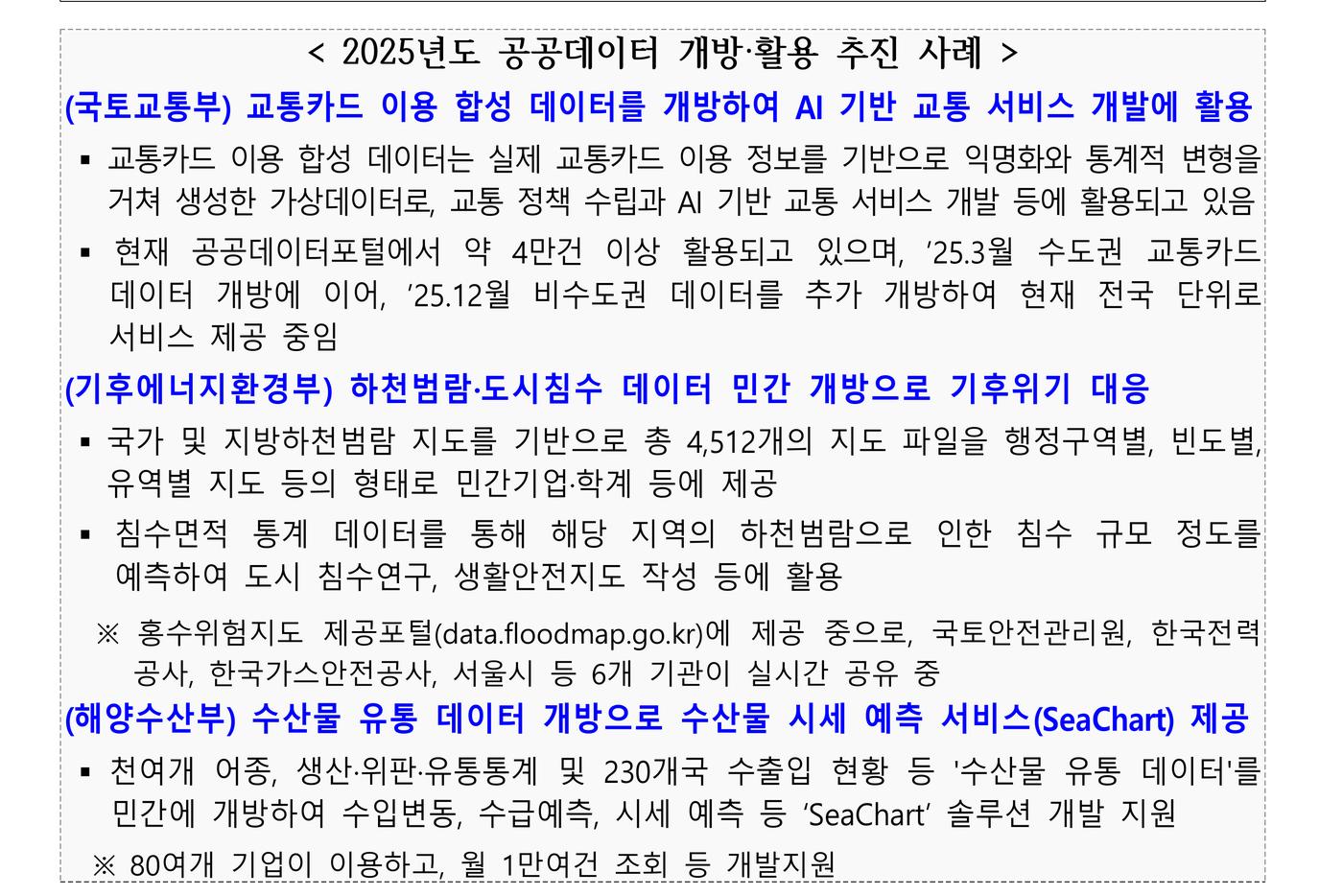
What the transit card case shows is an order of operations. The work of masking information that can identify a person while leaving the data useful came first, and the usage figures came after. 37.8 is a signal that many bodies are still stopped at that earlier stage.
The two items, set side by side, ask for different things. The table below breaks that difference into four questions.
| Management systems (89.5) | AI-friendly, high-value data opening (37.8) | |
|---|---|---|
| What it asks | Is there a system in place to manage the data? | Has data of high demand and high value actually been put out? |
| What answers it | A dedicated team, a named officer, completed training, documented procedures | A record of opening data that has been through de-identification |
| What it takes | Administrative process and organizational design | What the ministry calls "specialist technology" |
| Can a small body do it alone? | Mostly yes | Hard without dedicated staff |
▲ Pebblous summary — the character of the two axes, drawn from the published scores and the ministry's explanation. The detailed scoring rubric behind the indicators has not been published.
The 51.7 points between those two items read as a country whose public bodies have grown fairly comfortable with managing data and are still clumsy at turning that data into something AI can pick up. The first is a gate almost every body has passed. The second is one most have not.
The 2,219 File Datasets Untouched for Over a Year
The material Lee Sang-sik's office released carries numbers from outside the scores as well. Over the past three years, 2,219 file datasets went more than a year without an update. Of those, 1,129, more than half, came from local governments. Public institutions accounted for 735, central ministries for 278, and the remainder for 77.
Refusals to provide data sit in the same material. There were 3,834 over three years, and half of them, 1,918, came from local governments. The most common reason given was that the body does not hold the data, at 2,320 cases (60.5 percent), followed by the data falling under information exempt from disclosure, at 767 cases (20.0 percent).
The direction those two numbers point overlaps with the scores by institution type. Public enterprises and quasi-governmental institutions sit at 92.5 and central government agencies at 90.2, both in the nineties, while basic local governments are at 60.3 and other public institutions at 57.4. Top and bottom are 35.1 points apart. Among county-level local governments, 55 of 82 (67.1 percent) were graded 'poor' or worse. 'Other public institutions', the type at the bottom, is a category that bundles public research institutes, public foundations and public associations, and it gained 4.3 points on last year while staying in the 'poor' grade below 60.
What matters is that the bodies with low scores and the bodies where updates have stopped are the same ones. A line runs between bodies that can put someone on de-identification work and bodies that cannot, and that line follows size rather than will. The condition that basic local governments and other public institutions cannot easily staff a dedicated role stays in place after the evaluation ends.
Lee Sang-sik's proposal points at the same spot. Chief data officers should be given substantially stronger authority, he said, and effective indemnity guidelines should be enacted quickly so that working-level staff can open data without fear. Where a public servant carries the blame if data containing personal information causes trouble once released, putting the decision off is the rational choice even when the technical capability is there. The second most common reason for refusal, information exempt from disclosure, is unlikely to be unrelated to that structure.
Reporting on the same audit material carried the size of the portal as a whole. The public data portal has 11,960 open APIs registered, and applications to use them number more than 4.25 million. The report placed the 37.8 of the 'AI-friendly, high-value data opening' indicator in the sentence immediately after those two numbers. The number of windows opened and the applications to take data through them are already at that scale, and a separate reading of whether that data was ready for AI to use returned 37.8. What point in time the two numbers are counted as of is not stated in the report.
The 2,219 datasets untouched for more than a year count toward the number of opened datasets all the same. They are up on the portal and can be downloaded, so they are open data. For anyone trying to put them into training or prediction, the situation looks different. Data whose as-of date cannot be established is hard to put straight into use. These 2,219 show that the measure counting how much has been opened and the measure asking whether it can be used are two different measures.
Why Pebblous Is Watching This Evaluation
Results like these are usually consumed as a report card for public bodies. From a seat where data gets handled, something else shows up first. A government scorecard that comes round every year now has an item asking whether AI can use the data, and the first year's result there was 37.8. It amounts to measuring 684 bodies at once and receiving the current level of AI-ready data as a single number.
The gap is not confined to the public sector. Companies with data management systems in place routinely find, as they begin an AI project, that their own data does not go straight in. A management system answers where the data is and who is responsible for it. It does not ask whether the data is in a shape that can enter a model. Whether personal information is mixed in, whether updates have stopped, whether values are missing or labels misaligned: all of that comes out only when it is measured separately.
Three things are worth checking right now, whether you open data or take it in. When was the data you put out or brought in last updated? Who has checked that it still has value after personal information was processed out of it? And is there a single line in your own reporting that points at whether the data can actually be used rather than at how many datasets have been opened or held? If the third question has no answer, the 37.8 box is not yet on that organization's data report card either.
Where the ministry places this evaluation shows in the minister's remarks at the end of the release. Public data is a core asset that decides national competitiveness in the age of AI, said Yoon Ho-jung, the Minister of the Interior and Safety, adding that the ministry would open the Public Data TOP 100 in earnest so that public data becomes a foothold for Korea's rise as one of the three leading AI countries, and would keep improving data capability and quality management across the public sector. The Public Data TOP 100 named there is the set of priority datasets whose opening schedule was pulled forward by a year, and an earlier article here went through its licensing terms. If TOP 100 is a list of what will be opened next, the 37.8 in this evaluation is a number for how far the capability of the side doing the opening has come.
The ministry said it will keep revising the evaluation indicators so that data of high demand and high value gets found and opened. Creating the item is half the work. Deciding how much of the capability to fill it is left to each body is the other half. In bodies that cannot staff a dedicated role, de-identification and quality checks have to run on tools rather than on hands before the numbers move.
Thank you for reading this far. The full results are in the Ministry of the Interior and Safety press release, and the audit reporting that carried the year-by-year trend is here. If you have taken data from a public data portal into real work, we would be glad to hear where it stopped you.
References
- 1.Ministry of the Interior and Safety. (2026-03-31). "2025 Public Data Provision and Operation Evaluation Results." Press release.
- 2.Bae Gun-deuk. (2026-10-06). "[2026 Parliamentary Audit] Public Data Opening and Use Score Falls for Second Year… AI-Friendly Data Scores 37.8." Dailian.