Executive Summary
NVIDIA has unveiled GR00T 2, a foundation model for robots. It was shown on November 9, 2026 at CoRL 2026, the robot learning conference held in Austin, Texas. Pretraining ran on 436,414 hours of recordings, and the portion of that produced by actually moving a robot, teleoperation, comes to 23,500 hours. The rest is first-person video of people working with a camera on their head, together with demonstrations people made using a gripper held in their own hands.
How much of the score the human video carries sits in NVIDIA's own ablation. Holding the architecture and the training recipe fixed and varying only the share of human video from none to 100%, progress across 72 real-robot tasks rose from 50% to 70%. The human recordings are what holds the performance up. The published 100,000-hour data card, meanwhile, gives the number of people who shot that video, 41,288, and never once uses the words consent, privacy, or personal.
Sections 1 through 4 report what NVIDIA's research page, data card, and model cards say. Section 5, which reads that composition from the position of a company putting a robot on its floor, is this article's own interpretation.
Key Numbers
Four figures below. The first two cover what this model learns from and what it manages to do; the last two point at the scale of the people who made that material and at what is not written down about them.
Source: NVIDIA GEAR, "GR00T 2: Scaling Robot Foundation Models for Generalization, Dexterity, and Adaptation" (November 2026) and the Human-1M-100K data card.
5.4%
Recorded by a robot
Teleoperation is 23,500 of the 436,414 pretraining hours. The remainder came off human bodies
95%
Success after five demonstrations
Average over 50 tasks picked from those five demonstrations can teach. 37 of them succeeded in every trial
41,288
People who shot the public slice
Collectors in the 100,000-hour release, which also holds 81,557 scenes and 3.4 million episodes
0
Mentions of consent in the data card
Consent, privacy, and personal appear nowhere in the body. Supplier identifiers remain as folder names
A Little Over One Hour in Twenty Comes From a Robot
GR00T 2 uses what NVIDIA calls a world-action model. A single diffusion transformer reads recent video, the instruction and the robot state, then denoises future video and a chunk of robot actions together, executes the chunk, and repeats. Training the half that predicts how a scene will change needs video and nothing else, and no robot has to appear in that video. This design is what rearranged the composition of the training material.
NVIDIA lists three kinds of pretraining data. 402,730 hours of egocentric video of people at work; 10,184 hours of demonstrations with a handheld UMI gripper across 2,897 tasks; and 23,500 hours of robot teleoperation. The teleoperation side spans parallel-gripper arms (YAM and Franka), dexterous hands (Sharpa and Wuji), and the Unitree G1 humanoid. The three add to 436,414 hours, and the share a person produced by driving a robot is 5.4%.
Put the gripper demonstrations and the teleoperation together and they come to 7.7%. Both are records a person made with their own body, yet signal taken straight off a robot's joints accounts for 23,500 hours and no more. Teaching a robot has come to need very little robot, and on cost that ratio makes sense. An hour that accumulates only while someone stands at a robot and drives it, and an hour that accumulates while someone does their ordinary work on camera, do not carry the same price.
Move the training material toward people and the number of robots stops being the bottleneck. The bottleneck moves to people instead. Shooting 400,000 hours takes 400,000 hours of somebody working, and that work has to be on camera.
Nineteen in Twenty After Five Demonstrations, on Tasks Picked for That
What a model trained this way actually does was measured on 50 tasks. Each one appears in other robots' data or in human video and never in the training data of the robot used for evaluation. Run with no robot data at all, GR00T 2 succeeds in 40% of trials, and on 40 of the 50 tasks it succeeds at least once. One demonstration per task lifts that to 71%, and five lift it to 95%. Five demonstrations amount to under three minutes of robot data, followed by a LoRA adapter fine-tune that takes roughly 30 minutes on a single RTX 5090. Under those conditions 37 of the 50 tasks succeeded in every trial. Three contact-rich insertion tasks went through one further round of reinforcement learning on the real robot and reached 88 to 96%.
One condition travels with those numbers, and NVIDIA wrote it into the whitepaper. The evaluated tasks were selected among those the model can learn with five episodes at a success rate of at least 80%. So 95% covers less ground than "hand it any new task and it will manage nineteen times out of twenty." It sits closer to "a task five demonstrations can teach, it will almost certainly learn." Because the selection rule is written down, how far the number travels can be read alongside it.
Speed was published too. GR00T 2 Turbo, the lighter version, is a two-billion-parameter joint video-action transformer, and one prediction takes 124 milliseconds onboard the Jetson Thor carried by a Unitree G1, or 38 milliseconds on an RTX 5090. NVIDIA reports that its optimizations cut median prediction latency by 66 to 86%. The parameter count of the base GR00T 2 is not given on the research page.
Coverage of the launch mostly carries the numbers this far. On the data side, the thing worth more attention is the ablation NVIDIA published alongside them. Holding the architecture, the recipe, and the teleoperation post-training all fixed, it pretrained four models on none, 1%, 10%, and 100% of the human video, then put each one through the same 72 Dexter tasks.
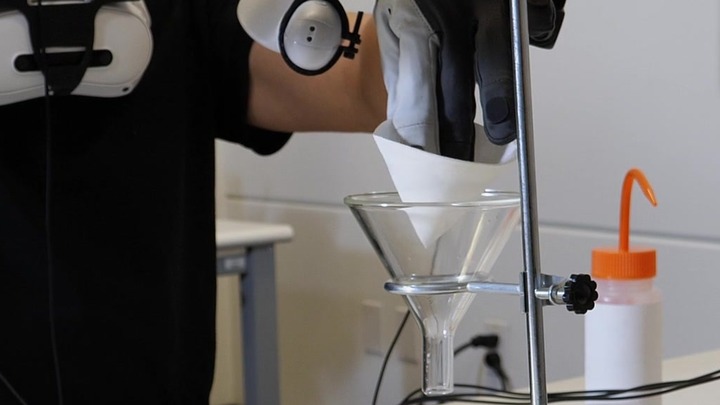
Human demonstration
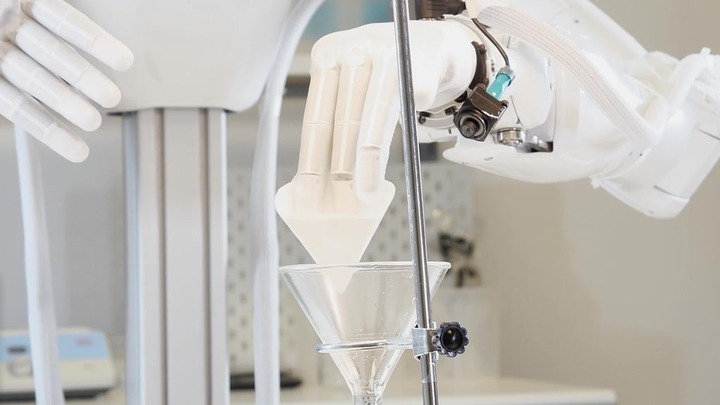
Dexter's replay
The model given all the human video went from 64% to 77% in video rollouts and from 50% to 70% on the robot. NVIDIA plotted the share on a log axis and drew one standard deviation across repeated runs as error bars, and what the chart is there to say is plain enough. What was learned from human footage carries over into a robot's body. Reading the 20 points on the real robot as human video's share of the scorecard is not a stretch.
The ablation matters for a separate reason. A composition figure of 92.3% says nothing about whether that data contributed to the score. It could have gone in by the hour and earned little. The ablation removes that possibility. NVIDIA has itself pointed at human video as the main ingredient of the training, which makes where that ingredient came from a question for whoever adopts the model.
That Video Arrives as a Weekly Delivery
The 402,730 hours of human video come from a one-million-hour collection NVIDIA calls Human-1M. 100,000 hours of it are open on Hugging Face as Human-1M-100K, licensed CC BY 4.0 and cleared for commercial use. The public slice on its own holds 3,405,573 episodes, 406,815 recorded task clusters, 81,557 scenes, and nine environment categories. Video runs at a minimum of 30 frames per second and 480p, with stereo head and wrist views, 6-DoF head-camera pose, and 21 keypoints per hand recorded alongside it.
What was filmed is written down as well. Taking the data card's own examples: sewing lace fabric, repairing motorcycle brakes, filling dumpling wrappers, polishing dental crowns, assembling toy gears, packing shipping cartons, chopping cabbage, harvesting tomatoes, bundling glass bottles. Every one of them is somebody's working day. The environment categories run along the same grain: industrial workspace, on-site repair workshop, commercial kitchen, service counter and care, studio workbench, logistics floor, agriculture, household, eight of the nine the card counts. Filming happened both in the wild, in real homes and workplaces, and in studios set up to make the same skill repeatable. Annotation arrives in two layers, a one-or-two-sentence summary of the goal of the whole episode, and segments of one to ten seconds naming which hand did what verb to which object.
How the data was gathered shows up elsewhere in the same card. The release is organized by vendor → batch → version, and the directory name itself is vendors/{vendor_id}. The quality audit history is kept on the same frame: across 25 delivery weeks, 561,000 accepted hours and 461,000 gross rejected submission hours. Close to half of what came in fell short of the bar and went back, and that history says something else as well. The video is not something NVIDIA went out and shot. It arrived from outside, week by week, as deliveries.
That changes how the figure of 41,288 collectors reads. These are not subjects assembled in a lab but people who filmed by way of a number of suppliers. The data card counts them. It does not record who they are or on what terms they filmed.
Search the body of the data card for consent, privacy, personal, or ethical and nothing comes back. The quality gates themselves are thorough. Annotation accuracy, task quality, diversity, and 3D tracking validation are all checked, through human review and quantitative tests together. What those gates examine is whether the video is fit to train on, not whether the person in it knew what it would train.
NVIDIA Already Has the Form for This
NVIDIA attaches a Privacy Subcard to its model cards, a form whose rows ask whether personal data was used, whether consent was obtained, and whether a deletion request can be honored. On EgoHand-v1, the company's own egocentric hand-motion model, that form is filled in and published.
Here is what EgoHand-v1's subcard answers. Personal data was used in training, consent for it was obtained, and NVIDIA did not collect that data itself. On what disclosures went to the data subjects, the entry reads Not Applicable. And to the final question, whether a correction or removal request can be complied with, it answers as follows.
| Privacy Subcard field | EgoHand-v1's answer |
|---|---|
| Personal data used to create this model? | Yes |
| Was consent obtained for any personal data used? | Yes |
| Is a mechanism in place to honor data subject right of access or deletion of personal data? | Yes |
| If personal data was collected for the development of the model, was it collected directly by NVIDIA? | No |
| If personal data was collected for the development of the model by NVIDIA, do you maintain or have access to disclosures made to data subjects? | Not Applicable |
| Is there provenance for all datasets used in training? | Yes |
| Is data compliant with data subject requests for data correction or removal, if such a request was made? | "No, not possible for externally sourced data." |
▲ Seven rows from the Privacy Subcard of NVIDIA's EgoHand-v1 model card. There are thirteen in all, and the thirteenth is a link to the company privacy policy.
Two rows inside the same form answer differently, and that is the point of the table. The fifth row says yes, a mechanism is in place to honor a data subject's right of access or deletion. The last question, whether an actual correction or removal request can be complied with, is answered no, with externally sourced data given as the reason. The mechanism exists; it does not reach video bought from outside. What decides where the right stops is the procurement path rather than the nature of the data. EgoHand-v1's description of its training data points at the same place: “In-house purchased real-world egocentric hand data: RGB image/video of hand motion captured with head-mounted egocentric cameras, sourced from 3rd-party data vendors.”
The model card for the predecessor, GR00T N1-2B, sits in a similar state. Its data collection method is one line, “Hybrid: Human, Synthetic,” and the Explainability, Bias, Safety & Security, and Privacy Subcards are only pointed at, with readers referred to the subcards for more detail. GR00T 2's weights and code are due in December, so no model card exists yet. The documents available from outside today are the research page and the Human-1M-100K data card, and the data card carries no link to a subcard either.
This is not a blank left by the absence of a form. A form the same company already filled in once, for the same kind of first-person data, is not attached to the largest first-person collection it holds. When the model card arrives in December, that box is the one to check.
Why Pebblous Is Watching GR00T 2
Physical AI's training material shifting toward people is not one company's choice. This blog has covered Alibaba teaching a humanoid from 500 hours of first-person video, and has sorted robot learning data into layers to see which layer is empty. What is different about GR00T 2 is scale. Once 500 hours becomes 400,000, who got filmed stops being a footnote in research ethics and becomes a supply chain question.
For a company about to bring a robot in, this structure raises three questions. First, is there a channel for asking what the model learned from? What can be confirmed about GR00T 2 from outside today ends at how many hours were shot and how many people shot them, and past that lies supplier territory, out of view. Second, if a person who was filmed raises an objection later, how far does responsibility run for the company using the model? EgoHand-v1's subcard answered that correction and deletion requests cannot be honored for externally sourced data, and what that answer means for that company is not spelled out. Third, when our own company films people to make data, what has to be written down alongside the footage?
The third question is the closest one for Pebblous readers. Plans to film staff at a factory or a store in first person and feed that to robot training are already under review in a number of places. For a plan like that, the Human-1M-100K data card is at once a good example and an empty field. Leaving a vendor, a batch, a version, a scene identifier and a collector identifier on every episode, and attaching audit history by delivery unit, is worth taking over as it stands. What remains is raising what notice the person filmed received, how far the video may be used, and how long it will be kept into fields of the same spec sheet.
None of this argues for leaving the data alone. That first-person video lifts a robot's score by 20 points is something NVIDIA demonstrated experimentally, and with returns like that this direction keeps going. But when the résumé of that material gives nothing past the hours, a company bringing the model in ends up using it without knowing what it brought in. When Pebblous says AI-Ready Data, provenance belongs inside that phrase next to quality.
Thank you for reading this far. What NVIDIA announced is on its research page, and the 100,000 published hours can be inspected directly in the Human-1M-100K data card. Among the models your team runs, how many have you followed all the way back to what they learned from?
References
NVIDIA Research
- 1.NVIDIA GEAR. (2026). "GR00T 2: Scaling Robot Foundation Models for Generalization, Dexterity, and Adaptation." NVIDIA Research, November 9, 2026.
- 2.NVIDIA GEAR. (2026). "GR00T 2 Whitepaper." NVIDIA.
Data and Model Cards
- 3.NVIDIA. (2026). "PhysicalAI-Human-1M-100K." Hugging Face Datasets.
- 4.NVIDIA. (2026). "EgoHand-v1." Hugging Face Models.
- 5.NVIDIA. (2025). "GR00T-N1-2B." Hugging Face Models.
📚 Physical AI Datasets Hub
Articles on how the data robots learn from gets gathered, what shape it piles up in, and where its provenance runs out. See more in the Physical AI Datasets hub