Executive Summary
Meta released Muse Glimmer on August 10, 2026. It is an open-weight model that compresses 30 billion parameters into 4-bit so it runs on a personal PC or Mac with a single graphics card. The announcement is explicit about the purpose. An agent that manages your calendar, drafts your messages, and organizes your files needs deep access to personal context, so the inference should never leave the device.
What this arrangement changes is not the performance chart but the origin of the input. When you call a cloud API, the model's ability comes from the pretraining data the provider assembled, and that data was never something you could touch. What an on-device agent actually reads on every request is the files, calendar entries, and messages stored on that machine. A variable that used to be out of reach is now within reach, and the responsibility for maintaining it came along with it.
Sections 1 and 2 stay with what the announcement and the reporting said. Our own reading starts in Section 3.
Key Numbers
The first two numbers are the conditions that let this model sit inside a personal device. The last two are where it wins and where it loses against open models of the same weight class.
Sources: Meta AI Research, MarkTechPost
55GB → 18GB
Model size after 4-bit quantization
Fits on one 24GB VRAM consumer GPU
120K+ tokens
Context it can read at once
Sized to take in whole local documents and schedules
75.5 vs 62.5
MCP-Atlas tool-calling score
Against Qwen3.6-27B, an open model of the same class
65.9 vs 75.6
OSWorld computer-use score
Driving the screen directly is where it falls behind
Thirty Billion Parameters on One Laptop
Muse Glimmer is a 30-billion-parameter dense multimodal model released by Meta Superintelligence Labs. The license is Apache 2.0 and the weights are open. It was distilled using the outputs of Muse Spark, Meta's top-tier closed model, as the teacher signal, which makes it something close to a scaled-down Spark by lineage. It takes text and images and returns text, and its knowledge cutoff is January 4, 2026.
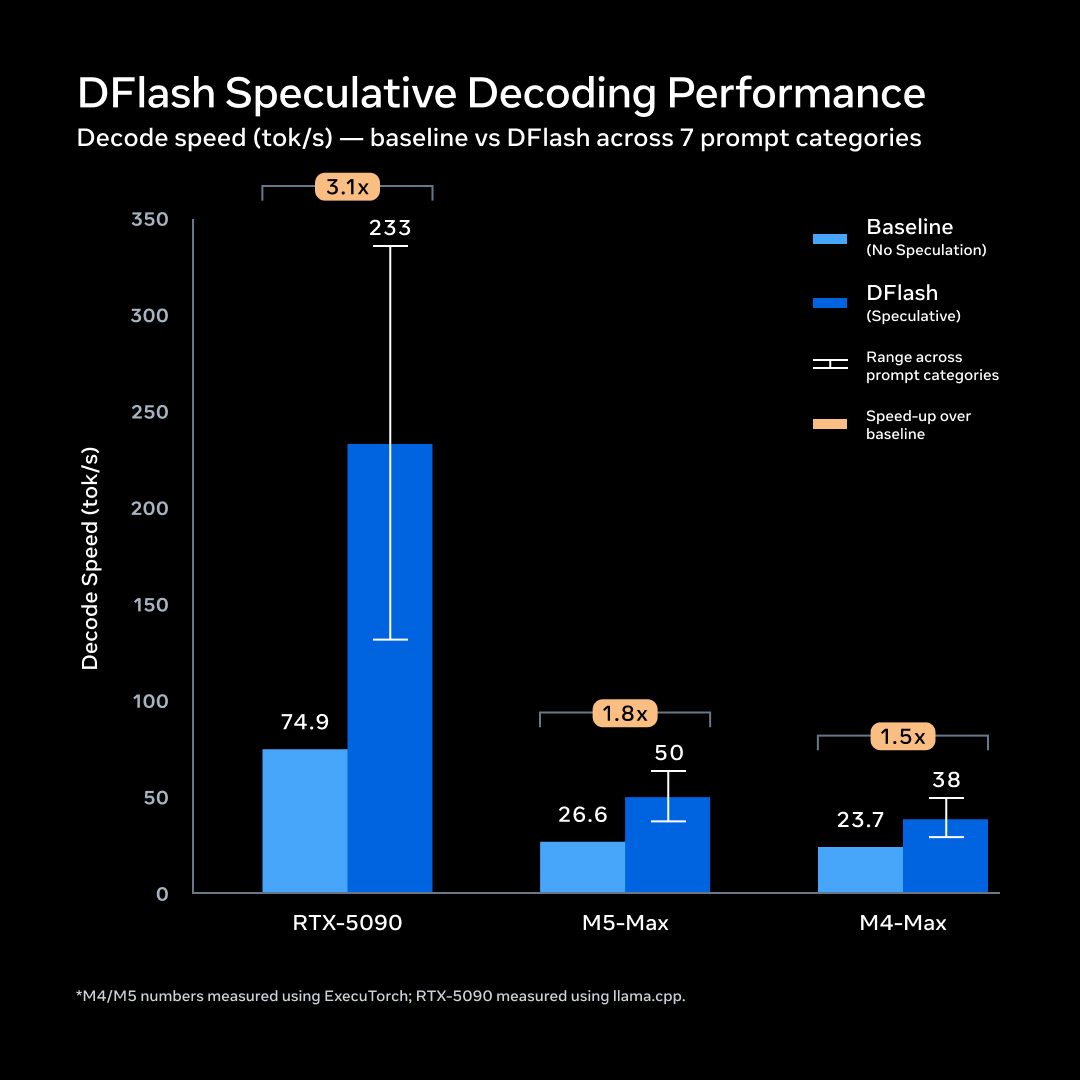
The condition that lets it sit inside a device is size. At full precision it exceeds 55GB and will not fit on consumer hardware, but the 4-bit quantized builds come down to between 18GB and 20GB. Meta shipped two of them. The build for 32GB of VRAM loses 0.2% of average performance; the 17GB build targeted at 24GB loses 1.0%. Generation speed is pushed 1.5x to 3.1x higher by a drafter called DFlash that predicts 16 tokens at a time. On an RTX 5090, 74.9 tokens per second became 233.4, and on an Apple M5 Max, 26.6 became 50.2.
The distribution channels opened alongside it. Hugging Face carries the BF16 original, GGUF quantized builds, ExecuTorch builds for mobile and embedded targets, and the DFlash drafter that raises throughput. Integration with llama.cpp and MLX is announced as coming soon, and the model supports more than 100 languages. In other words, anyone can put it on their own hardware and run it without going through one company's app.
The benchmarks show plainly what the model was built for. On tasks that call tools and chain multiple steps together, it pulls well ahead of its comparison set. MCP-Atlas 75.5 is a wide gap next to Gemma4-31B at 54.2 and Qwen3.6-27B at 62.5. DeepSearch QA 74.6 and AIME 2026 94.7 point the same way. On OSWorld-Verified, which asks the model to look at a screen and drive the mouse and keyboard, it scores 65.9 against Qwen's 75.6, and it also trails on terminal work and SWE-Bench Verified. Planning and calling tools is the strong side; operating the screen by hand is still the weak one.
Why Meta Wants This Model on Your Device
Meta states the reason up front in its announcement. An agent that manages schedules, drafts messages, organizes files, and learns how you work needs deep access to personal context, and that context contains personal files, conversation history, credentials, and internal company documents. For workflows that handle material like this, the announcement says, inference staying on the device is a precondition.
TechCrunch read the release as the first concrete artifact of the personal superintelligence idea Mark Zuckerberg has been describing. The line Meta drew is worth noting. The model people own and run themselves is open, while the more capable intelligence the company keeps control of stays closed. Glimmer is open and Spark is not. The technology outlet MarkTechPost added regulated industries, air-gapped environments, and data residency requirements to that list. With no network calls at all, the reasoning goes, the data never crosses a border.
One more condition follows from this design. Because inference finishes inside the device, it works whether or not there is an internet connection. Zuckerberg's remark as relayed by TechCrunch runs in the same direction: when superintelligence is spread across individuals instead of pooled in a handful of servers, an era of expanded personal capability opens up.
That is where the announcement and the coverage stop. Looked at from the data side, though, one thing quietly changes places. In the era of calling a cloud API, what governed the quality of an answer was the pretraining data the provider had assembled. How that data was collected and cleaned was not our business, and what we sent was a few lines of prompt. What an on-device agent reads on every request is different: the attachment that arrived yesterday, last week's meeting notes, the entries still sitting in the calendar, the PDFs piling up in the downloads folder.
The left side of the diagram below is the arrangement we have had so far. The basis of the model's ability sits with the provider, and we take the result and use it. The right side is the arrangement Glimmer assumes. The weights are identical for everyone, but the input layered on top of them differs from device to device.
Your Messy Folder Becomes the Evidence
From here on, this is our reading. Meta's announcement goes only as far as saying the agent accesses personal files to manage schedules and organize documents. Nowhere does it say that how well those files are organized decides the result. Read what follows as how the arrangement looks to people who work on data quality.
The benchmark profile from Section 1 overlaps here. What this model does well is plan and call tools and chain several steps together. That also means it moves on to the next step whether the evidence it picked was right or wrong. The advantage of running without a connection cuts the same way. During the hours when there is no external source to check an answer against, the files on the device are the only evidence available.
A 120,000-token window looks generous, but it is not infinite. You cannot pour every document on a laptop into it, so the agent has to choose which files to read each time. The clues it chooses by are file names, folder locations, modification times, and a few lines inside the document. If those clues mean nothing to a human eye, they mean nothing to the model either. Between "proposal_final_reallyfinal_v3(1).pptx" and "proposal_final_reallyfinal_v3.pptx", the file system holds no answer as to which one actually went out.
The table below sets common states of local data side by side with the failures they produce in agent work. Most of the items on the left are things that caused no real trouble as long as one person was working alone. A stale entry left in the calendar is something a person skips over after glancing at the date, but an agent that reasons from the calendar reads that line as a valid fact.
| State of the local data | What the agent runs into | Symptom a person notices |
|---|---|---|
| Three copies of the same document | No basis for deciding which of three files with different numbers is authoritative | A different figure surfaces in every summary |
| File names with no convention | The first clue for choosing what to load into context disappears | Answers cite the wrong document |
| An uncleaned calendar | Cancelled or past events read as the current state | Scheduling is based on a meeting that already happened |
| A downloads folder of unknown origin | Documents with no trust rating enter with the same weight as internal material | An outside claim comes back out as our conclusion |
Compiled by Pebblous. The contents of this table are our reading, not part of Meta's announcement.
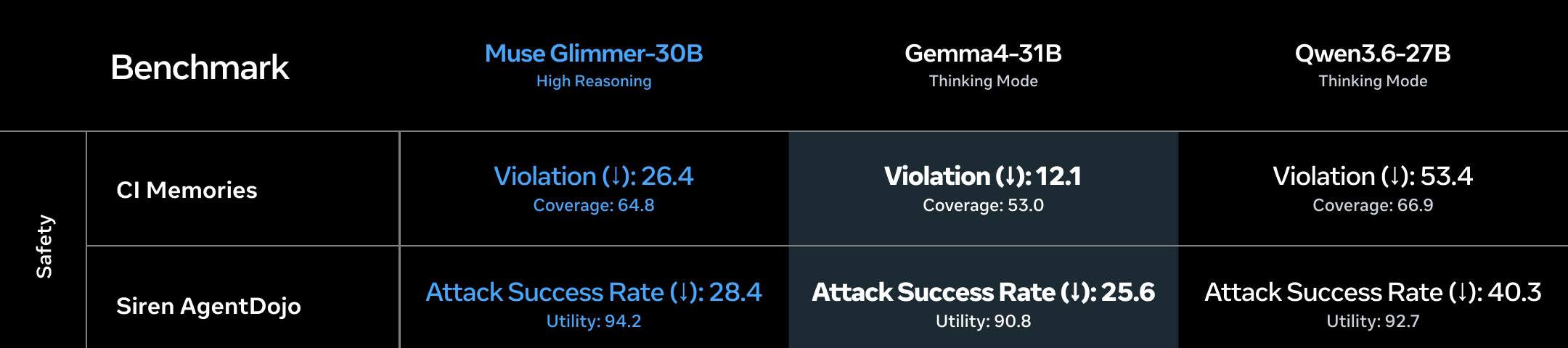
That last row is not only a performance problem. In the safety measurements Meta published alongside the model, Glimmer recorded a 28.4 attack success rate on Siren AgentDojo. Instructions planted inside a document moved the agent in close to three out of ten attempts. If the documents in your folder are the input, then that folder is the attack surface.
The Judge Moves Onto the Device Too
One more passage in the announcement stands out. Meta lists Glimmer's uses as function calling, desktop agents, and coding assistance, alongside synthetic data generation and LLM-as-a-judge evaluation. The model was tuned for the role of judging another model's output.
The context Meta gives for that use is the developer workflow: run large-scale scoring of model outputs locally, without paying for API calls. That is as far as Meta's framing goes. If the ability to judge quality has become a component that runs without a network, then deciding whether a document is a duplicate, whether a figure is current, and whether two sources contradict each other can also happen on the device. The yardstick for evaluating data moves from a cloud service to the seat next to the file system.
The yardstick that arrives has no markings on it. What counts as a duplicate, how many days old makes a document stale, which of several departmental definitions is authoritative, none of that is settled by the model. Without written standards, the model's defaults become the organization's standards. At that point the organization is having the state of its own data graded against criteria it did not write.
Those defaults are not empty, either. Glimmer was distilled using outputs from Muse Spark, Meta's closed higher-tier model, as the teacher signal. If you do not write down the criteria for judgment, what fills that vacancy is the criteria the teacher model acquired during training. Which document counts as current, which notation counts as canonical, gets decided outside our hands.
Owning the tool that judges and owning the criteria it judges by are two different jobs. This release hands the first one to everyone for free. The second is still something each organization has to write.
Have We Ever Measured Local Data Readiness?
When we have talked about preparing data for AI, the unit has been the dataset and the pipeline. Setting collection rules, aligning schemas, and measuring label quality belonged to the data team, and the subject was the assets that had already made it into the warehouse. The unit an on-device agent assumes is far smaller: one laptop, one shared team folder. That unit has never been the target of any quality metric.
An organization that wants to inspect this unit has three questions to ask. They are aimed not at the data sitting in the warehouse, but at the folders people open and close every day.
- How many files in this folder carry the same fact? What identifies the authoritative one among them?
- What distinguishes the documents here that are still valid from the ones that have expired? A date, or the memory of whoever opens them?
- Do materials from outside and materials approved internally sit in the same folder? If so, how is the agent supposed to tell them apart?
If the three questions have answers, that folder is ready for an agent to read. If the answers stall, the folder is still running on human memory. People fill the blanks from memory; 30 billion parameters running inside the device have no access to it.
Editor's Note: The situation Pebblous meets most often in data quality work is not one where nobody knows the data is bad. It is one where everybody knows it is bad and nobody has written down the standard by which it is bad. On-device agents drag that situation all the way down to the personal folder. The questions we used to ask only of the warehouse now have to be asked of the folder on the desk.
References
- 1.Meta AI Research. (2026-08-10). "Introducing Muse Glimmer: an open agentic model." Meta Superintelligence Labs.
- 2.TechCrunch. (2026-08-10). "Meta's new Glimmer AI model offers a hint at Zuckerberg's personal intelligence vision."
- 3.MarkTechPost. (2026-08-10). "Meta AI Releases Muse Glimmer."