Executive Summary
This article looks at a place where the unit of value on a book is changing. Mentat, a Korean book licensing company, opened Mentat Discovery on October 13, 2026. It is a window where an AI company can browse by category through about 34,000 books licensed from more than 90 Korean publishers, check on screen how much text that comes to in tokens and what it would roughly cost, and go on from there to a contract. Until then an AI company had to track down publishers one at a time and start every negotiation from the beginning.
The holdings on the marketplace come to about 8 billion tokens. Korean publishing counts that list in copies and the AI industry counts it in tokens, and Mentat did the conversion at the platform level before opening the door. A token count measures length and nothing more. Expertise and citation value do not show up in it, which is why Mentat did not let prices track token counts in a straight line.
Everything to this point is what Mentat announced and what Korean coverage recorded. Reading the overseas cases in section 4 as evidence that a token is only the unit a deal starts from, and all of section 5, is this article's interpretation.
Key numbers
Four cells. The first two are the same list seen through each industry's own measure. The second two are prices that have actually been put on books handed to AI, one in a commercial deal and one in court.
Source: Mentat's launch announcement and coverage by AI Times, ZDNet Korea and VentureSquare (October 13, 2026), plus overseas coverage of the Anthropic settlement.
About 8 billion tokens
The holdings on the AI industry's scale
Everything listed and searchable on Mentat Discovery. It comes in the unit AI companies work in, so size and likely cost can be read straight off the screen
About 34,000 titles
The same holdings on publishing's scale
Licensed from more than 90 Korean publishers. The two cells are not two different things; they are one list, and only the unit changes between the two industries
About 10 billion won
Mentat's cumulative contract value
As disclosed in August 2026. About 50 Korean publishers had joined, academic presses and magazines among them, and a licensing contract with a global big tech company was included
About $3,000 a work
A price signal that went through a US court
The roughly $1.5 billion Anthropic settlement with authors, divided across about 500,000 works, as the figure has been reported. It was set per work rather than per token
The Window Mentat Discovery Opened
What an AI company does on Mentat Discovery comes in three steps. It searches licensed books by field and category. It reads off the screen how many tokens that bundle holds and roughly what it would cost. It then picks a mode of use and moves to a contract. The modes split in two: taking the books as a dataset file for training a model, or taking them through an API that lets an AI consult the text and show the source as it answers. Mentat labels the two Training Dataset and Citation API.
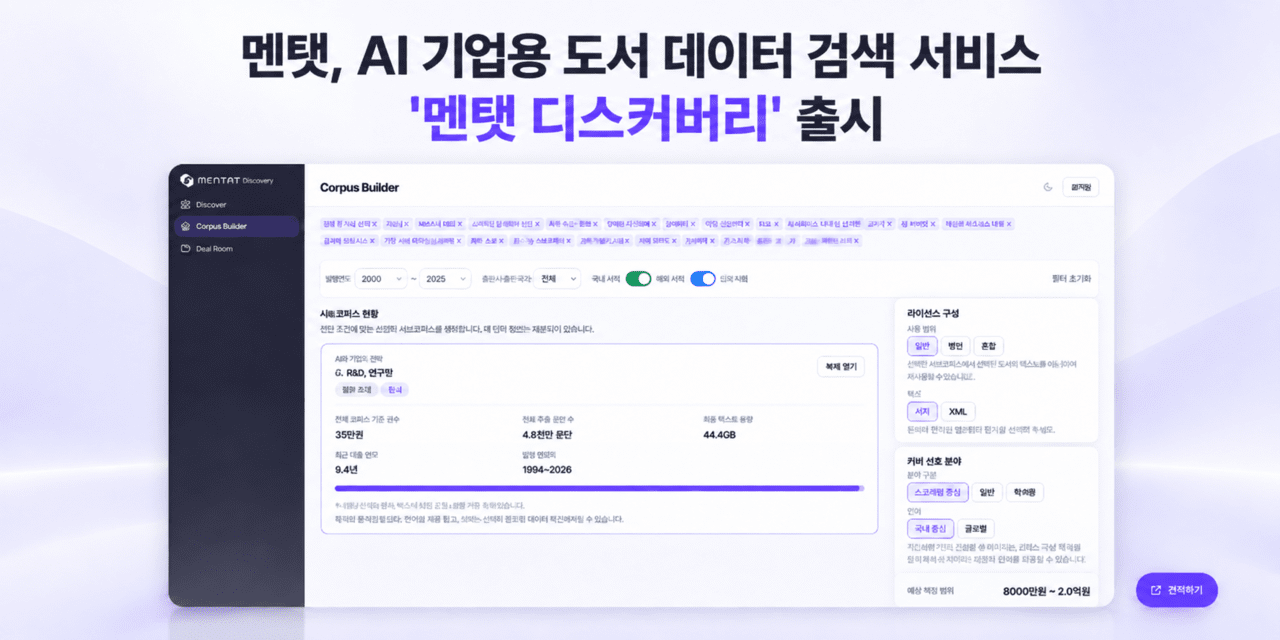
That third step is not a stamp pressed on the screen. A buyer who has checked size and cost requests the detailed catalog, and the contract discussion starts from there. The books are grouped by what is inside them rather than by publisher or year of publication, so a buyer narrows down from whichever field they came for.
Having those three steps on one screen is what changed. Before this, an AI company asked around for publishers holding usable books, checked who owned which rights, and negotiated volume and price publisher by publisher. No list existed anywhere showing which publisher held how many books in which field. Mentat built that list and wrote token counts and estimated costs onto it.
"We focused on letting AI companies easily find books whose licenses are properly cleared and put them to use right away."
Byung Wook Jeon, CEO of Mentat, at the launch announcement of October 13, 2026, translated from the Korean
Mentat was founded in July 2025. Jeon came to it from leading the digital business team at the publisher Changbi and from new business at Kakao Entertainment, and has said the company started from the view that a Korean publisher negotiating alone has little leverage against a global AI company. Mentat raised pre-seed funding from Antler Korea and was selected for TIPS, the startup program run by Korea's Ministry of SMEs and Startups. In August 2026 the company disclosed an AI licensing contract with a global big tech firm, and the cumulative contract value given at that point was about 10 billion won across some 50 participating publishers. The figure given at this launch, two months later, is more than 90 publishers under contract.

The stake an individual publisher puts on this marketplace is not small either. Jpub, a specialist IT publisher, agreed to supply about 100 titles of technical and computing books as training and citation data and to be paid according to use. One field's specialist list went up as a single bundle.
The goal Mentat set out at launch does not stop at closing deals. Jeon said the company would widen a structure in which books are used more by AI and the revenue from that use flows back to publishers and authors. Opening a marketplace and making the money earned there run back to the people who made the books are not the same undertaking, and the second one depends on how prices get set.
One Side Counts Copies, the Other Counts Tokens
Publishing counts its goods in copies, printings and print runs. The number written into a contract is a royalty rate, and how many printings a book went through is its report card. The AI industry counts the same prose in tokens. How much a model can read at once is counted in tokens, so is the size of the data that went into training, and so is the bill for using it.
One side says a book printed 3,000 copies, and the other asks how many tokens the data comes to. So the first job at the negotiating table was conversion. Counting the characters in a book, working out how many tokens that makes, and each side guessing from its own instincts what that volume should be worth: the whole sequence ran again every time the publisher changed. The line Mentat used to describe Discovery points straight at that spot.
"Mentat Discovery shows publishers' books in the tokens and costs an AI company is used to, so that both sides can review the data against the same yardstick."
Mentat launch announcement, October 13, 2026, translated from the Korean
A platform doing the conversion in advance also means that one of the two units has become the common language. That common language is the token. The diagram below sets out how one list ends up carrying two different numbers.
What a Token Count Measures in a Book
A token count is a conversion of length. It is the number of pieces the characters break into for a model to process, so a thick book has many tokens and a thin one has few. It measures nothing past that. Three hundred pages holding thirty years of specialist knowledge and three hundred pages written in a day are not told apart by token count, and whether the content can be found anywhere else does not show up in it either. A token is a ruler for thickness, not for worth.
Mentat did not let price track token count in a straight line either. It split the modes of use in two and gave them different billing. One is taking a dataset for training; the other is having an AI consult a book and cite it each time it answers.
| Mode of use | What the buyer receives | How the price is set |
|---|---|---|
| Training | A dataset file for model training | A one-time flat fee bounded by the contract term and the model families it covers. Once the file is taken, it ends inside that scope |
| Reference and citation | An API that looks into the books and attaches the source when answering | Metered: token consumption plus a minimum guarantee plus a revenue share. It accumulates every time the book is used |
What those two rows actually are is set down in the announcement as well. The dataset that goes out for training is in a file format such as JSONL, and it carries more than the body text: title, author, publisher and ISBN travel with it. The citation side runs by finding the relevant book passages and presenting the source as the AI builds an answer. The price is counted in tokens, and yet what gets pulled up for a single answer is a passage inside a book rather than a whole book.
Splitting the two moves the token count to a different place. On the training side a token count is a volume you compute once. On the citation side, how many times a book actually went into an answer keeps accumulating. Training pays two books of the same length the same; under reference and citation, the more often a book is cited the more it earns. Jeon has said the citation model will become publishing's real source of revenue.
Being paid by use requires the uses to be visible. Mentat attached a dashboard to its API gateway so that authors and publishers can see in real time which questions their books were cited in and how often. They can also see how their citation levels compare with other publishers'. Jeon has described Mentat as an operating system for copyright resting on the consent of rightsholders, with rights clearance, content preparation, quality assessment, usage measurement and settlement strung into one line.
Once settlement hangs on usage, measurement becomes money. The amount is set not by how many tokens were handed over but by where and how often the handed-over tokens were used. In that structure a seller of data has to watch more than the volume label. It has to watch whether a trustworthy record of use is being kept.
What Should Cost More at the Same Length
Mentat is not alone in trying to price books in tokens. The price signals that have surfaced so far use different units from one another. The largest sum yet moved inside a courtroom, and the unit used there was not the token.
The amount Anthropic agreed to pay to settle a class action by authors was reported at about $1.5 billion. That money goes out across about 500,000 works, which has been put at roughly $3,000 a work. It is not a structure in which a book twice as long is paid twice as much. The first large price signal to pass through a court was set per work.
On the other side sits the Publisher Content Marketplace that Microsoft opened in early 2026. Publishers post their terms and prices and AI companies license from the catalog, and coverage of the launch describes usage-based royalties counted in tokens. The shape matches Mentat's citation model. Book publishers have been slower to join, by those same accounts, and HarperCollins is understood to have negotiated separately at around $5,000 a title.
| Price signal | Unit the price was set in | What that unit rewards |
|---|---|---|
| Anthropic settlement | The work — about $3,000 a work, as reported | The fact that a work was used at all. One work is one work, whatever its length |
| Microsoft marketplace | The token — usage-based royalties | Volume actually consumed. Content in heavier demand is paid more |
| Mentat Discovery | Listed in tokens, billed by mode of use | Training buys one pass; reference and citation meter the usage as it accumulates |
With the three rows side by side, the reach of the token becomes visible. A token is the common unit that lets a deal begin. It gets both sides looking at the same screen and puts a first number on the table. The final amount is settled outside the token.
Three things pull that amount apart. The first is the mode of use. Training a model once or calling a book up on every answer turns the same book into a one-time flat fee or a meter that keeps running. The second is how hard the content is to replace. Field knowledge that is difficult to find elsewhere, like Jpub's technical list, has little that can stand in for it even when the token count is small. The third is exclusivity. Whether the terms give one AI company sole use or sell to several at once moves the price a long way.
So the same 8 billion tokens are not uniform inside. Which of two equally sized bundles should cost more is not a question that counting tokens more precisely will answer. It gets answered when the mode of use, the difficulty of replacement and the exclusivity terms are spelled out next to the data. A volume label is the starting line of a deal, and the information that separates prices has to be attached after it.
Why Pebblous Is Watching Mentat Discovery
Preparing data so that AI can use it usually brings cleaning and labeling to mind: removing duplicates, fixing formats, raising quality. The Mentat case lays another layer on top of that. Rights have to be cleared, the volume has to be stated in a unit both sides know, and the material has to be in a state where a price can be put on it before an AI company will move to a contract. However good the data, a negotiation does not start without that state.
At this point the meaning of prepared data widens by one notch. Quality metrics alone do not make a transaction. Whose rights these are, how far they can be used, and how much there is have to be written beside the data. Mentat's work reduces to one sentence: books were turned into a shape a price can attach to.
A training file carrying title, author, publisher and ISBN alongside the body text is what that shape looks like in practice. Hand over the body text alone and the receiving side gets a good pile of prose with no way to trace which book a sentence came from. An identifier has to sit next to the text for rights to be checked and for settlement to follow later. Whether an ISBN field is present does not change the quality of the data, and it does change whether the data can be traded.
Measurement hanging on settlement is worth noticing too. In citation billing the usage record is the invoice. Without a record of which passage of which book was used for which question, there is nothing to settle against. The demand that data stay traceable after it has been handed over is an old piece of unfinished homework on the training data side. Sources and terms of use that were not kept with the data cannot be restored later.
Questions are left open as well. Once token labeling settles in, the market will separate into cheap tokens and expensive ones. Settlement by citation frequency can then work in favor of books that are already widely read. How to treat a book that sold little and is hard to replace is a question nobody has answered. It arrives after a common unit has lowered the threshold of negotiation.
Thank you for reading this far. More on the Mentat Discovery launch is in the Korean-language coverage by AI Times and VentureSquare. Does the training data your team uses carry, alongside the text, the right and the scope to use it? We would be glad to hear from you.
References
Korean Launch Coverage
- 1.AI Times. (2026). "Mentat launches 'Mentat Discovery,' an AI licensing marketplace with 34,000 titles from 90+ publishers." (Korean)
- 2.ZDNET Korea. (2026). "Mentat launches 'Mentat Discovery,' a book-data search service for AI companies." (Korean)
- 3.VentureSquare. (2026). "Mentat officially launches book-data marketplace 'Mentat Discovery'." (Korean)
- 4.Maeil Ilbo. (2026). ""Books AI will read, searchable by token"—Mentat launches book-data marketplace." (Korean)
Mentat Background & Business Coverage
- 5.Kyosu Shinmun. (2026). "Seeing exactly how often AI has cited my book." (Korean)
- 6.VentureSquare. (2026). "Mentat supplies 100+ Jpub IT titles to AI." (Korean)
- 7.E-today. (2026). ""Content AI reads earns revenue too"—Mentat and BravoMyLife." (Korean)
- 8.Mentat. (2026). "About Mentat."
International Comparison Sources
- 9.Quartz. (2026). "The price of AI training data, from $5M to $250M."
- 10.Winbuzzer. (2026). "Microsoft Launches Publisher Content Marketplace for Content Licensing."
- 11.The New Publishing Standard. (2026). "Microsoft Launches Publisher Content Marketplace. Book Publishers Look The Other Way."
- 12.Troveo. (2026). "AI Data Licensing in 2026: How Deals Work and What Data Costs."
- 13.AI Industry Reviews. (2026). "AI Training Data Licensing Deal Statistics: 2026 Report."