Executive Summary
Google DeepMind has shipped a world-generating model that invents the sound along with the scene. Genie 4, released as a research preview on October 27, takes a description in plain language and produces not only the place but the ambient noise and music that belong to it, plus characters who talk back to what the user types. DeepMind calls it its first real-time world model to generate audio natively.
The same announcement carries a robotics demonstration. Gemini 4 Argon breaks down the task of Apptronik's Apollo humanoid playing a game of checkers, and Genie 4 simulates those steps in real time. Yet in that same post DeepMind also writes that complex physical interactions and long-term consistency are still active areas of ongoing research. The use case of teaching robots and the admission that the physics is not settled sit on one page together.
Sections 1 through 4 follow what DeepMind's own post, TechCrunch's reporting, and a prior study that evaluated synthetic-trajectory-trained robot policies on real hardware actually record. Section 5, which argues that verification does not get easier as generation scales up, is this article's reading.
Key Numbers
The first card is a number for what Genie 4 can do. The other three belong not to Genie 4 but to other world models doing the same job, measured on real hardware, and Section 4 explains why.
Sources: TechCrunch (2026-10-27) · arXiv 2607.29302 WorldArena evaluation · Google DeepMind
2 min
How long a scene holds together
TechCrunch reports this as double the predecessor's limit. DeepMind's own post gives no such figure
25
Synthetic trajectories a world model supplies per task
A policy trained on that data is then run 100 times per task on a real robot to measure success
14–58%
Success rates earned by five public world models
Same two tasks, same conditions. Lowest and highest are more than four times apart
71.5%
Success rate of a policy trained on real data
The bar synthetic trajectories have to clear. With no added trajectories at all the score is 3.50%
What Genie 4 Gained Is Sound
Genie 4 arrived on October 27 as a research preview. Access is limited to trusted testers for now, and DeepMind says it will soon open to Google AI Ultra subscribers in Project Genie and to early access partners of the Gemini API and Google AI Studio. This is not yet something anyone can switch on.
What separates it most sharply from the previous model is sound. DeepMind introduced Genie 4 as its first real-time world model to generate audio natively. A generated scene arrives with the ambient noise of that place, and the characters in it hold conversations that respond to what the user does. Sound is not laid over a finished video; it comes into being while the world is running.
The world can also be revised out loud while it runs. The examples DeepMind gives in its post are changing the weather, moving the camera, and introducing a new person or object, with Gemini adapting the instruction to fit the surrounding scene. The feature assumes a way of working where you open one scene and keep adjusting it, and that assumption comes back in Section 3, because repeated editing is one of the conditions DeepMind names for drift. TechCrunch calls the feature real-time steering and reports better physics and more humanlike characters than before. Diego Rivas, an engineer at Google DeepMind, told TechCrunch where that real-time quality earns its keep.
"The real time aspect becomes most valuable in the areas where keeping a state of flow in the creativity space becomes incredibly useful."
1.1Where the Two-Minute Figure Comes From
Most of the coverage led with two minutes of scene consistency, double the predecessor's limit. That sentence belongs to TechCrunch. DeepMind's own post carries no such figure. What the post says is that Genie 4 can maintain coherent environments over short sessions, and it never pins the duration to a number of minutes.
The subtler part is the predecessor. The Genie 3 post from August 2025 describes worlds you navigate in real time at 24 frames per second, retaining consistency for a few minutes at a resolution of 720p, with visual memory extending as far back as one minute ago. So the one-minute figure does exist. It is just not the length of time a scene holds together; it is how far back the model can reach into what it has already seen. For consistency, the word DeepMind used was minutes, plural and unnumbered.
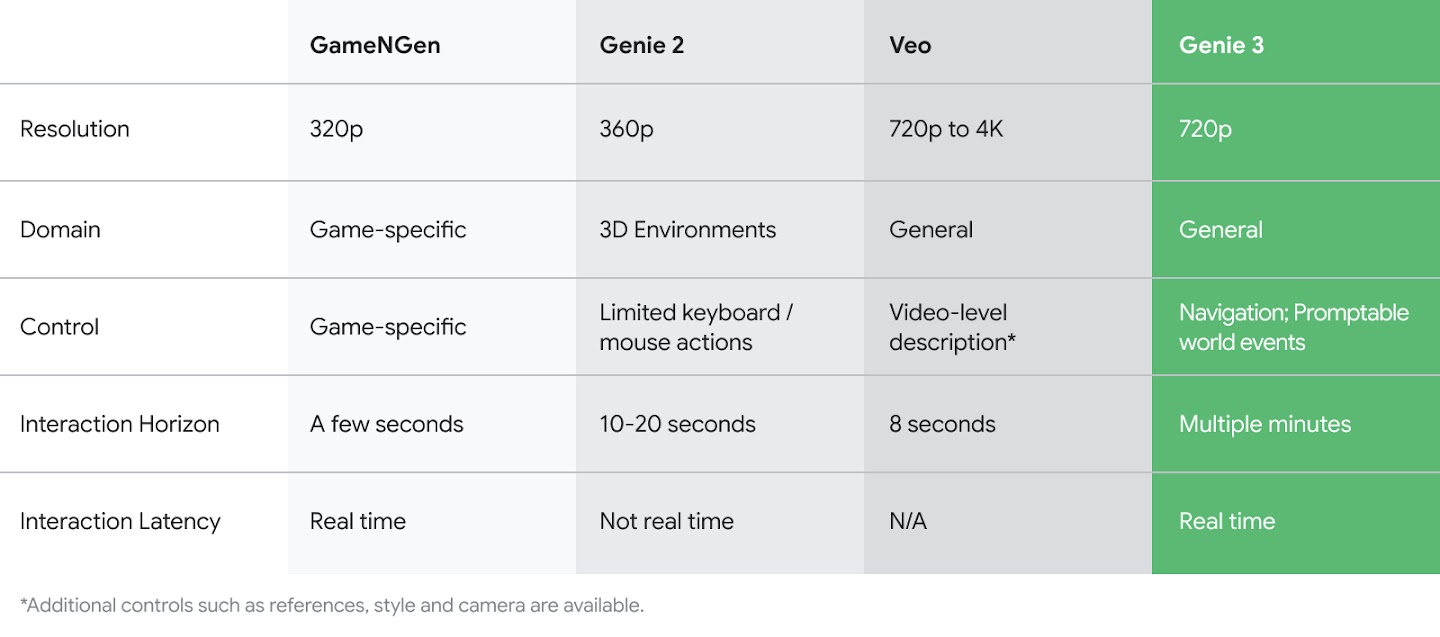
The arithmetic of doubling only works if those two quantities trade places. Put the predecessor's one minute of visual memory into the consistency slot, set it beside the successor's two minutes of consistency, and you get a clean factor of two. But what that same post recorded for consistency was a few minutes, and between a few minutes and two minutes you cannot even establish an increase. Reading this as capability standing still would be wrong. It means the two numbers were taken with different instruments, and how much actually improved cannot be settled from the published documents.
One thing is stated plainly. All video and audio generated by Genie 4 carries SynthID, DeepMind's imperceptible digital watermarking technology, which marks both the picture and the sound as machine-made without anything a person would notice. The means of telling the output apart later shipped alongside the model itself.
The Supervisor Only Ever Sees the Generated World
Genie 4 does not run alone. DeepMind writes that Gemini 3.8 Flash serves as a guiding agent in the loop: while Genie 4 generates a world in real time, Gemini continuously observes the scene, breaks goals down into a sequence of steps, and reviews incoming frames to track progress. Splitting the goal into steps and deciding whether the current frame has cleared one of them is the supervising side's job.
The robotics demonstration shows what the arrangement is for. In the case DeepMind published, Gemini 4 Argon and Genie 4 work together to simulate Apptronik's Apollo humanoid playing a game of checkers, breaking the task down into real-time steps. Speaking to TechCrunch, Google research director Tejas Kulkarni described the pairing this way.
"What we'll increasingly see in the future are these hybrid world models, where you have a combination of Gemini writing code and text, and Genie ingesting that in real time and simulating reality at different levels of abstraction."
Keeping the generating side and the judging side apart is a shape reliable agent systems commonly take. The New Stack covered Genie 4 under a headline aimed squarely at the physics not being right yet. One point is worth adding here, though. The frames Gemini supervises are frames Genie 4 generated. So what gets judged is whether something is plausible inside the invented world, not whether it matches real physics. That distinction is not one DeepMind draws, and it is this article's reading.
The Homework DeepMind Wrote Down Itself
The densest passage in the announcement is the one on limitations. DeepMind's sentences read as follows.
"While it can maintain coherent environments over short sessions, visual details and object permanence can still shift or drift over time—especially as a simulation runs longer, after multiple complex prompt edits, or when navigating throughout the scene. Complex physical interactions, real-time audio accuracy, rendering legible text, spatial accuracy, and long-term consistency are active areas of ongoing research."

Three conditions for drift are written down there. Running longer, editing repeatedly, moving around inside the scene. Lay those three over the work of producing robot training data and the overlap is not small. Pulling a large volume of trajectories means running long, building variations by changing conditions means editing repeatedly, and manipulation tasks generally happen while moving through a scene.
The list of remaining problems points the same way. Complex physical interactions and spatial accuracy sit close to the core of what a manipulation robot has to learn. Picking something up, pushing it, fitting it into place — all of that hangs on exactly those. That DeepMind put this list in the same post as the robotics demonstration means it disclosed the gap rather than hiding it. It does not mean the disclosed gap has been filled.
What the announcement lacks is a number. There is footage of the checkers demonstration, but no figure anywhere in the post for how many times out of how many a behavior trained in that simulation succeeded on a real robot. A scene that displays a capability and a measurement of whether the capability transferred are different kinds of evidence.
A Report Card for Robots Taught by Synthetic Trajectories
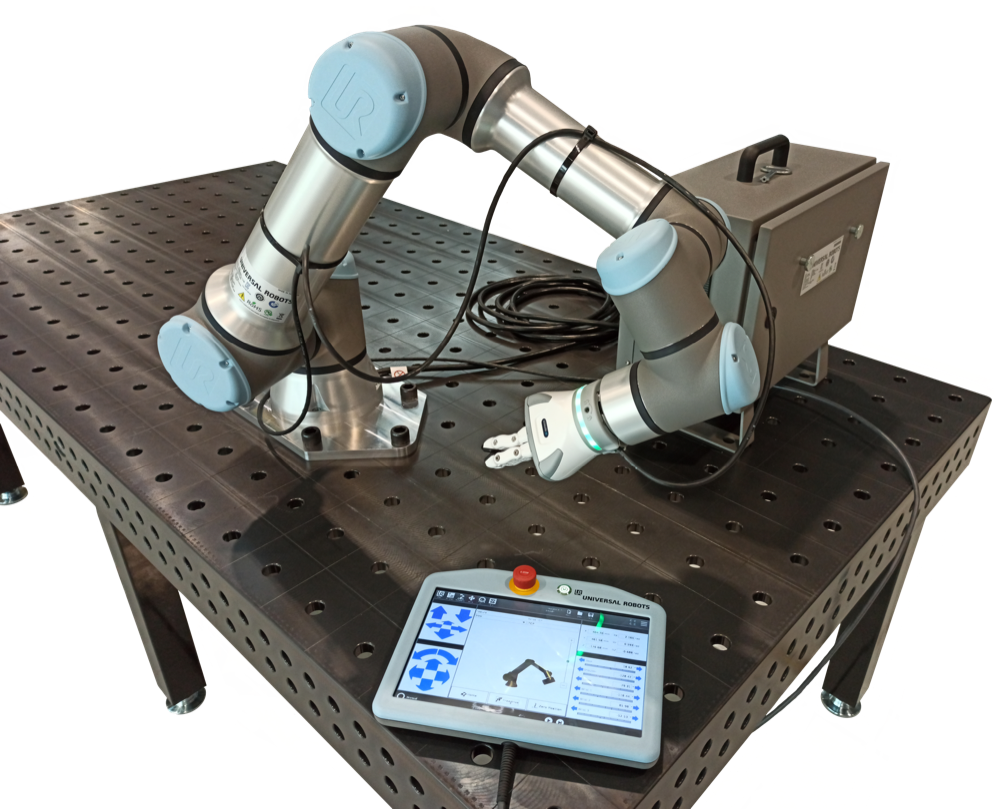
Measuring whether behavior learned in an invented world holds up in the real one has already begun. Academia has its own instrument for this. The BWM paper, posted on July 31 this year, is one case of that instrument being used. Put a world model in the role of data engine, train a robot policy on the synthetic trajectories it produces, then run that policy on a real robot and count the successes.
The conditions are simple. In the WorldArena evaluation, each world model supplies 25 synthetic trajectories for each of two tasks. A π₀.₅ policy is trained on that data and evaluated over 100 executions of each task on a real robot. A policy trained on data actually collected for those same two tasks serves as the baseline. The baseline scores 77.00 on adjusting a bottle and 66.00 on clicking a bell, averaging 71.50. The floor is recorded too. A policy that received no added trajectories at all averages 3.50. A synthetic trajectory's grade has to be read as a position between those two values.
Nine rows made the table. The floor and the baseline take one each, and seven supplied synthetic trajectories. Rather than the paper's own ordering, they are listed here from the lowest score up.
| Who supplied the training data | Average success rate over both tasks | Note |
|---|---|---|
| None (zero-shot) | 3.50% | A policy that received no added trajectories at all |
| Genie Envisioner | 14.00% | A public world model. The name resembles it, but this is AgiBot's separate model, not part of DeepMind's Genie line |
| TesserAct | 18.00% | A public world model |
| Wan 2.2 | 28.00% | Not a world model but a general-purpose video generator |
| Vidar | 33.00% | A public world model |
| RoboMaster | 37.50% | A public world model |
| WoW | 58.00% | The strongest alternative data source the paper names |
| Real collected data | 71.50% | The bar synthetic trajectories have to clear |
| BWM | 94.50% | The model belonging to the team that published this table |
There are two ways to read this table. One is pessimistic. Four of the five world models land between 14.00% and 37.50%, short of the 71.50% from real data. The other is optimistic. In the same table WoW reaches 58.00%, close on the baseline's heels, and BWM at the bottom clears it at 94.50%. That is a report of synthetic data producing a better result than real data.
That both readings come out of one table says something about what kind of report card this is. Same two tasks, same trajectory count, same number of executions, and the scores spread from 14.00% to 94.50%. And the highest cell is the value the team that published the table assigned to its own model. Holding up an instrument and confirming that the instrument was read fairly are still two different problems.
Two more things catch the eye on a pass up and down the column. Wan 2.2, a general-purpose video generator rather than a world model, beat two world models at 28.00%. The label world model does not guarantee better training data. And set against the zero-shot floor of 3.50%, all seven suppliers sit well above it. The conclusion that synthetic trajectories are useless does not come out of this table. What comes out of it is that results differ by more than a factor of six depending on where the data came from, which leaves the work of measuring suppliers.
Genie 4 is not in this table. The evaluation predates the announcement, and Genie 4 was not built to generate manipulation data in the first place. So these numbers cannot be used to grade it. What remains is a question of position. An announcement has arrived presenting itself as a supplier of robot training data, and the instrument for measuring such suppliers has already been built outside it. No one has yet put Genie 4 on that instrument.
Why Pebblous Is Watching Genie 4
The resolution and frame rate of world models are not something Pebblous needs to keep pace with. The reason to look closely at this announcement is that it marks a change in where the data for teaching robots comes from. Once a model starts inventing the footage people used to go out and film, the cost of increasing the volume of data falls sharply. The cost of confirming that the data is any good does not fall with it.
Footage collected in the real world carries one layer of quality guarantee built in: the fact that the scene happened. If a robot arm knocked a bottle over, that was a failure in real physics, and even if the label is wrong the event is true. A generated trajectory has no such guarantee. A success that looks smooth may be a motion that does not hold in real physics, and watching the video will not reveal the discrepancy. The distance between 14.00% and 94.50% in Section 4's table is exactly that discrepancy, counted on a real robot.
So verification does not get easier as generation scales up. If anything, the drift conditions DeepMind wrote down move in the same direction as volume. The longer you run and the more often you edit, the more data you have, and under those same conditions details and objects wobble. The more you make, the more there is to verify, and a band opens where each item is less trustworthy than before. An organization planning to use synthetic data for robot training would do well to settle three things first.
- What decides whether a generated trajectory passes. A person watching the video and calling it plausible is a different verdict from running it on real hardware and counting successes
- Who issues that verdict. It matters whether the score was assigned by the party that made the data or measured by an independent party under the same conditions
- Whether session length and edit count get recorded. The drift conditions are known, so keeping a note of which band a batch came from lets you pull the suspect batches later
What Genie 4 opens up is clear enough. A few words now summon a world that comes with sound, and a robot's movements can be stepped through inside it. The same announcement also records that the physics of that world is still under research. The two sentences are not a contradiction but a sequence. Inventing became possible first, and measuring whether the invention is right has to follow. The empty cell right now is the second one.
Thank you for reading this far. The native audio generation, the supervision loop, the robotics demonstration, the limitations list, SynthID, and the access tiers were all checked against the post DeepMind published on October 27. The two minutes of scene consistency and both quoted remarks come from TechCrunch's reporting, and the predecessor's 720p and 24 frames per second, along with its few minutes of consistency and one minute of visual memory, come from the Genie 3 post of August 2025. The conditions of 25 synthetic trajectories and 100 executions, and the nine rows of success rates, were checked against the WorldArena data-engine evaluation in Table 3 of arXiv 2607.29302. The observation at the end of Section 2 that the supervisor only ever sees the generated world, and Section 5's argument that verification does not get easier as generation scales, are this article's reading. If you have ever verified a synthetic-trajectory-trained policy on real hardware, we would be glad to hear what standard you used.
Pebblous Data Communication Team
October 29, 2026
References
Academic Papers
- 1.BWM Team. (2026). "BWM: A Low-Cost High-Fidelity World Simulator for Robot Learning." arXiv:2607.29302, July 31.
Official Documents
- 2.Google DeepMind. (2026). "Genie 4: A new generation of world simulation." Google DeepMind Blog, October 27.
- 3.Google DeepMind. (2025). "Genie 3: A new frontier for world models." Google DeepMind Blog, August 5.
Industry & Press
- 4.TechCrunch. (2026). "Google's Genie 4 world model adds audio, more realistic worlds and real-time steering." October 27.
- 5.TechCrunch. (2025). "DeepMind thinks its new Genie 3 world model presents a stepping stone toward AGI." August 5.
- 6.The New Stack. (2026). "Google built AI agents a world to practice in. The physics still aren't quite right." October.