Executive Summary
This article reads a single opinion released by China's State Council General Office on October 23 as a document about the data supply chain rather than as employment policy. The first of its eighteen points, arranged under six headings, places the core AI industries in the eastern provinces and sends data labeling and smart device manufacturing to the central and western provinces. The work of making training data has been named as an item in a country's industrial layout. The seven cities assigned to build data labeling bases had already been chosen in May 2024. This document adds a division of labor: the two regions are set on different layers of the same industry.
The seventh point of the same document calls for an employment risk assessment to be attached to AI projects, and it splits the target across two sentences. Where market entry is licensed, the assessment runs alongside the project review. For everything else, it is to be carried out according to actual conditions. Data labeling is not a business that needs a license to open. The very work this document sends inland sits, in that same document, on the side where no moment is named for the assessment to attach.
Sections 1 through 3 follow the wording of the document, together with the list of base cities and the occupational standard issued earlier by the National Data Administration and the Ministry of Human Resources and Social Security, and an industry report from CAICT. Section 4, which turns this layout into a question for the buyer of data, is this article's reading and is not in the document.

Key numbers
These three separate what the document created from what was already in place.
Source: full text of the State Council General Office opinion, as carried by Science and Technology Daily · National Occupational Skill Standard for AI Trainers (2021 edition)
March 2020
When AI trainer became a listed new occupation
Data labeler went in underneath it at the same time. This document did not coin the name
Five grades
Skill levels in the national occupational standard for AI trainers
Set in 2021. Data collection, processing and labeling are written as work for the bottom two grades
Two columns
How the employment risk assessment is divided
Licensed areas get it alongside review, everything else according to actual conditions. Labeling falls in the second column
Data Labeling Written Onto an Industrial Map
The document is titled "Opinions on Adapting to the Development of Artificial Intelligence Technology and Promoting the Building of an Employment-Friendly Development Model." The State Council General Office addressed it to the governments of every province, autonomous region and directly administered municipality, and to every ministry under the State Council. Its file number is Guo Ban Fa [2026] No. 29, it was signed on October 16, and it was published on October 23. The Korean coverage dated October 24 was working from that published version. Eighteen points are spread across six headings: strengthening the job-creating effect of artificial intelligence, building an employment-friendly path for AI upgrading, raising workers' digital literacy and employability, using AI to improve employment policy services, completing the systems that protect workers' rights and social security, and completing the monitoring, early warning and response system for employment risk.
For anyone reading from the data side, the point that matters is the very first one. Point (1), "Expanding the Employment Space of Artificial Intelligence in Emerging Fields," reads as follows. Deepen the implementation of the "AI Plus" initiative; encourage the eastern regions to lay out the core AI industries; and guide the central and western regions to take on upstream and downstream industries such as data labeling and smart terminal manufacturing, in line with local conditions.
One sentence holds two regions and two kinds of work. What the east is given is the core industry; what the central and western regions receive is the upstream and downstream. The verb rendered here as "take on" is chengjie (承接) in the original, and in Chinese industrial policy writing it usually means receiving a production process that is moving in from somewhere else. A verb that used to describe factory relocation has been attached to data labeling.
The "AI Plus" initiative named at the head of that quotation refers to a separate, higher-level plan. The State Council published the "Opinions on Deepening the Implementation of the 'AI Plus' Initiative" on August 26, 2025, setting staged targets for 2027, 2030 and 2035 across six fields: science and technology, industry, consumption, public well-being, governance, and international cooperation. This employment opinion borrows that plan's name and adds one sentence that splits the map.
Documents that place data labeling in particular regions are not new. On May 24, 2024, the National Data Administration announced at the Seventh Digital China Summit the seven cities that would carry the task of building data labeling bases: Chengdu in Sichuan, Shenyang in Liaoning, Hefei in Anhui, Changsha in Hunan, Haikou in Hainan, Baoding in Hebei, and Datong in Shanxi. Four of them — Chengdu, Hefei, Changsha and Datong — lie in the central and western regions. The stated criteria for choosing the cities included industrial foundation, strengths in human resources and digital-economy potential, alongside coordinated regional development. That December the National Development and Reform Commission, the National Data Administration, the Ministry of Finance and the Ministry of Human Resources and Social Security issued "Implementation Opinions on Promoting the High-Quality Development of the Data Labeling Industry," which set a target of more than 20% compound annual growth for the industry through 2027.
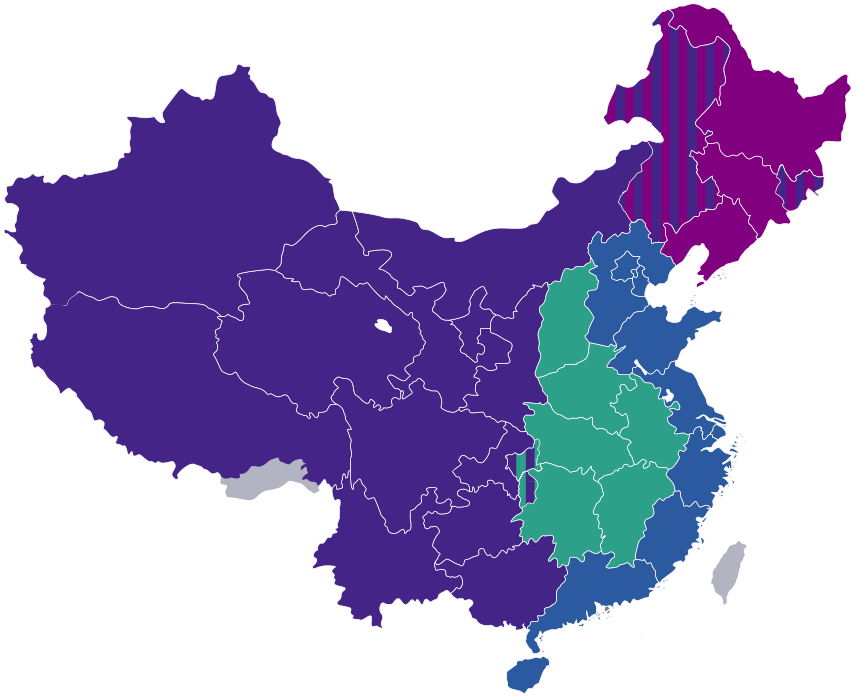
So the thing this document writes down for the first time is not the regional placement of labeling. Two things are new. A division of labor that hands the east and the central and western regions different layers now sits inside a single sentence, and that sentence appears in an employment document rather than an industrial development one. The December 2024 implementation opinions never use the phrase "central and western."
Because the placement came first, so did the tallies. The "Research Report on the Development of the Data Labeling Industry (2025)," published by CAICT in August 2025, reports what the seven bases have accumulated so far. The same report adds that as of the first half of 2025 these bases had built 524 datasets serving 163 large models.
Source: National Data Administration, list of cities building data labeling bases · CAICT and China Telecom AI, Research Report on the Development of the Data Labeling Industry (2025)
58,000
Labeling workers across the seven bases
A tally presented at the on-site base meeting held in Chengdu in March 2025
17,282TB
Volume of labeling the seven bases have built up
The report puts that at roughly six times the digital holdings of the National Library of China
8.3bn yuan
Related industry output the seven bases pulled in
The same tally says 223 labeling companies were attracted or grown there
On the buyer's ledger, where labeling gets done is still the client's own choice. The buyer weighs which vendor is cheaper, which country handles the language, which team can hold the quality bar. This document asks the same question in the language of administration. Which region will receive this work?
Two Columns Inside One Clause
The document is not only about making jobs. Point (6), "Easing the Employment-Displacement Effects of AI Application," gives instructions on both the order and the pace of adoption. Apply AI first where labor is short or the environment is hazardous; in labor-intensive industries, exercise prudence over the scope, intensity and rhythm of application so that the shock to workers is kept as small as possible. Companies are encouraged to explore an unemployment buffer period, to notify affected workers in advance during large-scale rollouts, and to provide support for transition and redeployment. The words "encourage" and "explore" are right there in the text. None of it is an obligation.
Point (7), "Establishing an Employment Risk Assessment Mechanism for AI Application," is the most concrete device in the document. The clause runs to two sentences. The first says that for AI application projects in market-entry fields that could cause a relatively large employment shock, an employment risk assessment shall be conducted at the same time as the project review, with the relevant departments arranging transition and redeployment support. The second says that for AI application projects in other fields, an employment risk assessment shall be conducted according to actual conditions.
A market-entry field is one where opening a business requires permission and review from a government department. Robotaxi services, which cannot operate without a license, belong there. The first sentence works because a place to hang the assessment already exists. There is a procedure, there is a department conducting it, and there is a moment at which it happens. The employment risk assessment rides on top of all three.
Data labeling belongs in the right-hand column. Opening a labeling firm involves no licensing review. It is low-threshold work, much like software development, and that is part of why the central and western regions can get started in it so readily. The same property works in reverse on the assessment side. With no review to hang it from, there is no fixed point at which the assessment happens. What the second sentence leaves behind is a single phrase: according to actual conditions.
One thing should be stated plainly here. Several commentaries, in China and abroad, have summarized this clause as leaving everything outside the licensed fields without any assessment rule, and that reading drops the second sentence. The second sentence clearly instructs that an assessment be carried out. What differs is not who is covered but when and through what procedure. In the first column the assessment attaches to the gate of a review; in the second, the clause names no gate for it to attach to.
Reading the monitoring clause alongside it shifts the picture somewhat. Point (16) calls for cross-departmental sharing of AI-related industry and employment data, and for jointly building regional and sector-level intelligent monitoring and analysis models for employment data. That means a field where no assessment attaches at the project level may still be picked up at the statistical level. But that is a net that gathers after the fact, while the assessment in the first column is a gate that catches before a project is approved. The two devices intervene at different moments.
These New Occupations Were Already on the List
Point (4), "Accelerating the Development of New Occupations in the AI Field," calls for faster development of new occupations and faster release of new occupational standards, centered on cultivating AI use cases and scaling them up, and for expanding demand for new occupations and new job types such as digitalization manager, AI engineering and technical personnel, and AI trainer. Most Korean coverage rendered this passage as the government naming new occupations.
The verb the clause uses is "expand" (扩大), and the object of that expansion is demand. It does not say that any name is being created. These names already sit inside China's national occupational classification. Digitalization manager was in the first batch of thirteen new occupations released in April 2019 by the Ministry of Human Resources and Social Security together with the State Administration for Market Regulation and the National Bureau of Statistics; AI trainer was in the second batch of sixteen released by the same ministries in March 2020.
The internal structure of the AI trainer occupation is the part to look at closely. From the day it was announced, it contained two sub-occupations: data labeler and AI algorithm tester. The labor of putting labels on data had already been given a slot inside the national occupational classification back in 2020, and the name on that slot was AI trainer.
In November 2021 the Ministry of Human Resources and Social Security and the Ministry of Industry and Information Technology issued the National Occupational Skill Standard for AI Trainers. The occupation code is 4-04-05-05, and skill is divided into five grades, from Level 5 (junior worker) up to Level 1 (senior technician). The standard also sets out which abilities belong to which grade. Data collection and processing, data labeling, and the operation and maintenance of intelligent systems fall in the bottom two grades, Level 5 and Level 4, while business analysis and intelligent training begin at Level 3 and above.
| Name | Listed as a national occupation | What this document says |
|---|---|---|
| Digitalization manager | April 2019 (first batch of 13) | Expand demand |
| AI engineering and technical personnel | April 2019 (first batch of 13) | Expand demand |
| AI trainer (sub-occupations: data labeler, algorithm tester) | March 2020 (second batch of 16) | Expand demand |
All three names were listed before this document. What the document writes down is not a name but demand.
Knowing that sequence changes how the clause in Section 1 reads. The work the central and western regions are to receive is not some new form of labor without a classification or a standard. The occupational name has existed for six years, the sub-occupation grouping for five, and the grade-by-grade skill criteria for four. What this document adds is a policy of growing that demand, and one clause that splits the same work between the east and the central and western regions.
Why Pebblous Is Watching This Document
Chinese employment policy is not Pebblous territory. This document, though, moves one phrase we use every day into a different place. "Cost of data preparation" is normally a procurement line item for us. You collect quotes, compare unit prices, set a quality bar, hold a delivery date. In this document, the same work is a line item in regional employment policy. And in the opinion's General Requirements section there is no target year and no figure. The numbers come instead from the base tallies seen in Section 1, and what those count is headcount, company count, output value and data volume. How evenly the labels were applied appears on neither side.
That is not to say the two collide. The point is that the metrics the buyer watches and the metrics the planner watches are different ones. The quality of labeled data comes, in the end, from how skilled the labelers are and how long they stay. Most of quality management consists of narrowing the spread in judgment on edge cases among people reading the same guideline, and keeping the criteria steady as labelers turn over. The five grades laid out in the national occupational skill standard from Section 3 exist for the same reason. The premise written into that standard is that skill has levels.
At this point two documents from the same country say different things. The industry report published by CAICT in August 2025 under the guidance of the National Data Administration states that as large models grow, labeling is shifting from labor-intensive to knowledge-intensive work. The criteria for judging a dataset have grown complex enough to demand deeper comprehension and analytical ability from labelers, and the workforce is moving from a vocational-college base toward bachelor's degrees and above, drawing in specialists from many fields. The employment document, meanwhile, writes the same work with the verb used for taking on a factory process. From the buyer's seat, the two sentences point at the same supplier.
The first two of the four conditions that same report lists for high-quality labeling are also worth reading. Factual accuracy means data from a specialized field should be handled by labelers qualified in that field. Semantic consistency means building a system of norms that runs across scenarios so that similar contexts yield the same judgment. Neither one rests on tooling. Both rest on people and on criteria.
So when this document is carried over to the side that buys data, three questions remain.
- Do you know which grade of skill produced the labels you receive? In a field where the standard already separates five levels, an order that never asks about grade is an order that asks only about price
- When the workforce moves to a region that has just been built up, do you have a way to confirm that the same guideline still yields the same judgment? Relocation means different people, and criteria wobble as people change
- In a stretch where policy has lowered the supply-side cost, do you separately measure what that lower price changes in your data?
Of the three, the second is the readiest to try. Build a bundle of edge cases out of the guideline you use today, and every time a supplier changes you can run the same bundle again and count where the answers diverge. While the supply chain moves around on the map, that is the kind of criterion you can keep in your own hands.
Thank you for reading this far. The clause quotations in this article were checked directly against the full text of the opinion as carried by Chinese state media; the occupational listing years and the grade system come from the new-occupation announcements and the national occupational skill standard published by the Ministry of Human Resources and Social Security; and the base city list and tallies come from the National Data Administration announcement and the CAICT industry report. We tried hard not to write that the document says something it does not. If you procure labeling overseas, we would like to hear how you confirm the skill level at the other end.
Pebblous Data Communication Team
October 25, 2026
References
Government and Official Documents
- 1.State Council General Office of China. (2026). "Opinions on Adapting to the Development of Artificial Intelligence Technology and Promoting the Building of an Employment-Friendly Development Model." Guo Ban Fa [2026] No. 29, signed October 16, published October 23. Full text via Science and Technology Daily (stdaily.com).
- 2.National Data Administration. (2024). "List of Cities Tasked With Building Data Labeling Bases." National Data Administration announcement, May 24, 2024.
- 3.National Development and Reform Commission, National Data Administration, Ministry of Finance, Ministry of Human Resources and Social Security. (2024). "Implementation Opinion on Promoting the High-Quality Development of the Data Labeling Industry." Fa Gai Shu Ju [2024] No. 1822, December 26, 2024. Published via gov.cn.
- 4.State Council of China. (2025). "Opinions on Deeply Implementing the 'AI Plus' Initiative." Guo Fa [2025] No. 11, August 21, 2025. Published via gov.cn.
- 5.Ministry of Human Resources and Social Security, Ministry of Industry and Information Technology. (2021). "National Occupational Skill Standard for AI Trainers." Occupation code 4-04-05-05. Full standard (PDF).
Industry Research
- 6.CAICT Institute of Artificial Intelligence, China Telecom AI Technology. (2025). "Research Report on the Development of the Data Labeling Industry (2025)." CAICT publication (PDF), August 2025.
- 7.China AI Dispatch. (2026). "China Will Screen Some AI Projects for the Jobs They Could Cut."
News Coverage
- 8.Pinpoint News. (2026). "China Grows Its AI Industry While Protecting Workers: Data Jobs for the Central and Western Regions," October 24.
- 9.CRI Korean Service. (2026). "China's State Council General Office issues 'Opinions on Building an Employment-Friendly Development Model in the AI Era'," October 23.
- 10.Nate News. (2026). "Coverage of China's State Council opinion on AI-era employment-friendly development," October 24.