Executive Summary
California's legislature has passed a bill that stops an employer from disciplining or firing an employee on the strength of an automated decision system alone. It cleared the Assembly on August 30 and the Senate on August 31, and was enrolled on September 4 as SB 947. The nickname is the No Robo Bosses Act, and the governor has not signed it yet. This article looks at what the text actually asks of an employer.
The text asks for two things, and both rest on the same condition. Where an employer relied primarily on the system's output, a human has to corroborate the decision using the data collected or used to produce that output. Separately, a worker may ask for a meaningful, objective description of their own data. Neither duty can be performed unless the data from that moment can be retrieved afterward. No provision in the part says how long to keep it.
Sections 1 through 4 follow only what is written in the two bill texts the legislature published, the vote record, and the veto message the governor sent to the Senate. Section 5 carries the question over to data practice, and that reading is this article's own.
Key Figures
Source: California Legislature, SB 947 bill text
$500
Civil penalty per violation
Section 1526.1(e). The Labor Commissioner and a public prosecutor enforce it, and subdivision (d) of the same section also opens punitive damages and attorney's fees
July 2027
When the law takes effect
The first of that month, set by Section 1526.7. Enrollment was September 4, and the governor's signing deadline is September 30
3
Uses no review can cure
Section 1522(a). Breaking the law, inferring protected status, and predicting the exercise of a right in order to punish it
0
Provisions setting a retention period
Explanation and corroboration are duties. No clause says how long to keep what they rest on
What Passed
SB 947 adds Part 5.5.5 to Division 2 of the California Labor Code. It runs from Section 1520 to Section 1526.7, eleven sections in all, and the moment it regulates is the one where an employer settles on discipline or termination. Promotion and pay decisions are not in it. Coverage carries no headcount floor, and government entities and labor contractors count as employers.
The ways around it are written down too. Section 1526.5 removes the parties to a collective bargaining agreement from coverage, but only where the agreement waives this part in clear and unambiguous terms, expressly provides for wages and working conditions, and provides protection from algorithmic management of its own. A waiver alone falls short; substitute protection has to come with it. Section 1526.6 exempts the development of aircraft for the national airspace and the development of products or services for national security, military, space, or defense purposes, and only so far as a federal statute, regulation, or binding federal contract requires. Section 1526.3 runs the other way: an employer who meets this part's notice requirements does not have to meet substantially similar notice provisions under other state law. That relief does not reach quotas as defined in Labor Code Section 2100, or other automated standards applied to working conditions.
Section 1520 defines what the law regulates. An automated decision system, ADS for short.
"any computational process derived from machine learning, statistical modeling, data analytics, or artificial intelligence that issues simplified output, including a score, classification, or recommendation, that is used to assist or replace human discretionary decisionmaking and materially impacts natural persons. An automated decision system does not include a spam email filter, firewall, antivirus software, identity and access management tools, calculator, database, dataset, or other compilation of data."
Four sources of computation open that definition, and only one of them is machine learning. A regression fitted to attendance records qualifies on the strength of that clause alone. Two further conditions then narrow the reach: the process has to issue something simplified, and it has to stand where a person would otherwise exercise discretion.
The second sentence subtracts. Between a database and a dashboard, the line falls on what a tool hands over rather than on what the vendor calls it. A database that only accumulates attendance records sits outside. The dashboard that turns those same records into a risk score on a manager's screen issues simplified output, so it sits inside. Call-center quality scoring and productivity rankings stand in the same place. This is why "we don't use AI" tends not to survive contact with Section 1520.
The core prohibition takes one line, in Section 1522(b)(1).
"An employer shall not rely solely on an ADS when making a disciplinary or termination decision."
Subdivision (a) of the same section sets apart three uses that no amount of human review can cure. Violating or preventing compliance with labor, occupational health and safety, employment, or civil rights law. Inferring an employee's protected status under Government Code Section 12940. And predicting that a worker will exercise a legal right, then taking adverse action for it. The schedule from passage to operation runs as follows.
| Date | What happened |
|---|---|
| October 13, 2025 | Governor Newsom vetoes SB 7, the predecessor bill |
| February 2, 2026 | Senator Jerry McNerney reintroduces a narrower version as SB 947. Senator Reyes and Assembly Members Kalra and Ward sign on as coauthors |
| March 26 to August 21 | Eight rounds of amendment, moving between the two chambers |
| August 30 | Passes the Assembly. 53 aye, 14 no, 12 not voting |
| August 31 | The Senate concurs in the Assembly amendments. 29 aye, 10 no, 1 not voting |
| September 4 | Enrolled and sent to the governor |
| September 30 | The governor's signing deadline |
| July 1, 2027 | The operative date set by Section 1526.7 |
The veto date is the one stamped on the message the governor sent to the Senate. The rest comes from the bill text and the vote record the legislature published. Abstentions appear in the journal as not voting (NVR). Whether the bill will be signed remained undecided as this article went out.
An Output You Can't Check Is One You Can't Use
Read the prohibition on its own and the fix looks cheap. Put a manager's signature under whatever the system concluded and it is no longer sole reliance. The very next paragraph closes that road. Where the decision rested primarily on the system's output, the employer has to direct the following.
"a human to corroborate the decision using data that was collected or used to produce the ADS output or other relevant corroborating or supporting information."
Notice which way that sentence points. Corroboration has to run from the data back to the decision, not from the decision back to a reviewer's judgment. Five kinds of material follow as examples, and the statute says in its own words that the list is not closed. One entry carries a clause worth marking: witness interviews, which may include relevant online customer reviews. A platform rating record is written into a labor statute there. Whatever the employer reaches for, the constraint in the first clause holds. A reviewer's account of having read the conclusion and agreed with it is not data that was collected or used to produce it.
Section 1522(c) settles what happens when corroboration fails.
"If an employer cannot corroborate the ADS output, or the human reviewer has concluded that the ADS output is inaccurate, incomplete, or misleading, the employer shall not use the ADS output to make a disciplinary or termination decision."
Two different situations arrive at one result. An employer who cannot locate the underlying data and an employer who locates it and judges it wrong both forfeit the same thing, which is the output. If the raw logs behind a performance score from six months ago are already deleted, that score has become material the employer may not decide on. The statute never orders anyone to retain data. It withdraws the use of the output from whoever did not.
Section 1524 lays a written notice on top, at the moment of decision. It has to state that the employer relied primarily on the system, that a human reviewed the decision and corroborated the output, contact information for a human who can say more, and that retaliation for exercising rights under this part is prohibited. It has to be plain language in a separate, standalone communication, in the language the company already uses for routine communications. The second item carries the most weight. A company that puts its corroboration in writing and hands it over has produced a statement that can be checked against the record later. Section 1526 restates the retaliation ban and names discharge, demotion, and suspension among the acts it covers.
One clause in the enforcement chapter sets the weight of everything above. Section 1526.1(c).
"once it has been demonstrated that an ADS was used to make a disciplinary or deactivation decision, the employer must demonstrate that the employer did not primarily rely upon an ADS or that the employer complied with Sections 1522 and 1524 when making the disciplinary or termination decision."
That sentence is built around a threshold and a choice. The threshold is low and it belongs to the worker: one fact, that an ADS was used in the decision. Everything past that threshold belongs to the employer, who then picks between two defenses. Either the reliance was not primary, or the employer met Sections 1522 and 1524. An employer makes either defense the same way, by producing what it had on hand at the time it decided.
This clause changes the character of every duty before it. Corroboration and notice stop being good practice an employer may adopt and become items the employer has to establish in its own favor once a dispute begins. Having no record means having no evidence, and in this arrangement the party without evidence is the employer.
How Far Does a Worker's Right to Ask Reach?
The second demand sits in Section 1522(d). Where an employer used the system primarily to decide on discipline or termination, the worker may ask for a description of their own data, and the employer has to hand it over.
"An employee shall have the right to request, and an employer shall provide, a meaningful, objective description of the employee's own data used by the ADS when an employer has primarily used an ADS to make a disciplinary or termination decision."
This is not a provision about how a model works. The object of the request is the worker, not the system. And Section 1520 draws employee data wide: any information that identifies, relates to, or describes an employee, regardless of how the information is collected, inferred, or obtained. Inferred values are named there, so an attrition risk score or an attitude index that a model built along the way counts as that person's data too. Keeping the original inputs does not answer the request.
The first subdivision of the same section widens the reach once more. ADS output covers not only information and data but assumptions, predictions, scoring, recommendations, decisions, and conclusions. The final score is not the only output, in other words; the assumptions and predictions the system formed on the way to that score are output as well. A design that discards intermediate values instead of logging them fares badly under that definition.
One more condition attaches. Section 1522(e) requires that the description be provided in a manner that anonymizes the personal information of customers, other employees, and other individuals. Handing over the whole bundle of underlying data is therefore closed off. To meet the request, an employer has to sort, value by value, what came from this person and what came from the colleague at the next desk or from a customer.
The capability this clause asks for is decomposition, not eloquence. Separating the data behind a decision by the person it came from requires that every value carry its own origin, its timestamp, and its route in. An organization that has not been accumulating data lineage cannot write its way out of this one.
Why Did SB 947 Pass After Last Year's Veto?
SB 947 is the second attempt. Its predecessor, SB 7, passed the legislature in 2025, and on October 13 Governor Newsom returned it to the Senate without his signature. The message he sent with it opens by granting the author's concern, that unregulated use of ADS by employers can be harmful to workers, and then gives three grounds for refusing. First, rather than addressing the specific ways employers misuse the technology, the bill "imposes unfocused notification requirements on any business using even the most innocuous tools." Second, the restrictions are overly broad, and the example he reached for was the clause barring customer ratings as the primary input data for an ADS, which he wrote "takes away a potentially valuable tool for rewarding high-performing employees." Third, he shares the concern about ADS-driven disciplinary and termination decisions, but holds that such situations are "partially covered by forthcoming California Privacy Protection Agency regulations," and that "Before enacting new legislation in this space, we should assess the efficacy of these regulations to address these concerns."
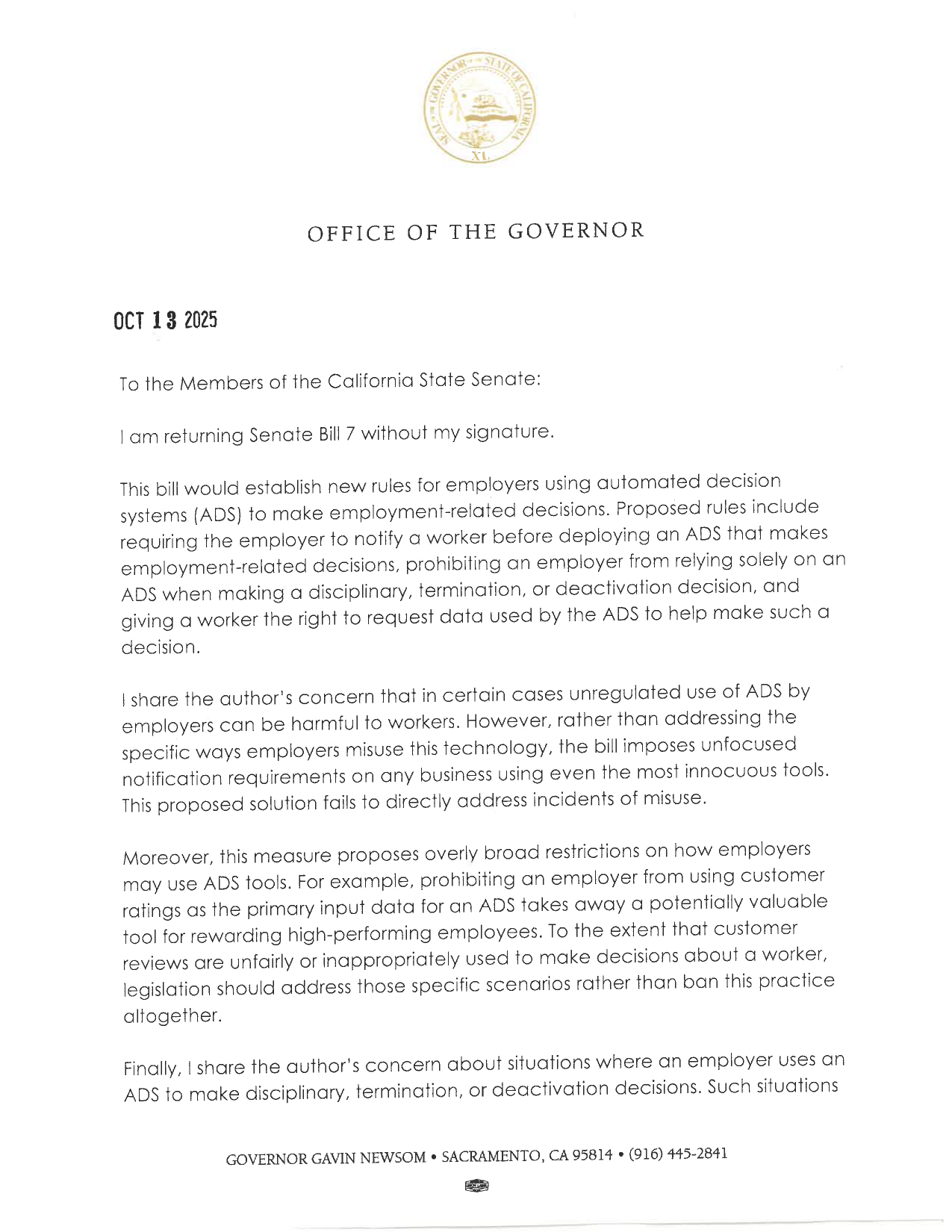
McNerney filed again in February 2026. Setting the two texts side by side shows what was taken out.
| Item | SB 7 (2025, vetoed) | SB 947 (2026, passed) |
|---|---|---|
| Who is protected | worker. Employees and independent contractors alike | employee. A person employed by an employer |
| Decisions regulated | Discipline, termination, account deactivation | Discipline, termination |
| Notice before use | Advance notice that an ADS is in use at the workplace (hiring decisions excluded) | None |
| Notice at the decision | Yes | Yes. Section 1524 |
| The worker's data right | A copy of the most recent 12 months of their own data, once every 12 months | A description of their own data. Section 1522(d) |
| Limit on customer ratings | Bars customer ratings as the only or primary input data for an ADS | None |
| ADS definition and exclusion list | Present | Identical. The sentence reads word for word the same |
Drawn from a direct comparison of the enrolled and final texts of both bills on leginfo.
The narrowing landed on who is protected, which decisions are covered, when notice falls due, and the limit that sat on input data. The definition did not narrow. Both the ADS definition and the exclusion list that runs from spam filters to datasets read the same in the two bills. The two clauses the veto message named are both gone. Out came the pre-use notice said to catch even innocuous tools, and out came the bar on customer ratings as a primary input. The method was to lighten duties rather than edit the definition. Broad prohibition gave way to narrow procedure, and the compliance burden moved with it, out of paperwork and into recordkeeping.
Customer ratings have not disappeared from the statute. The corroborating-information list in Section 2 above still carries that entry. The only thing removed is the limit on using ratings as the system's primary input. Consulting a rating while a person checks a decision stays open, and the clause that stopped a system from scoring on ratings alone was lifted.
The swapped data right runs straight into this article's subject. SB 7 told an employer to hand over a copy; SB 947 tells an employer to hand over a description. The copy obligation is gone while the corroboration duty and the explanation duty remain. An employer no longer has to pass the raw material across, and without the raw material neither duty can be discharged. For the record, the right to access one's data every 12 months that some legal commentary presents as part of SB 947 is an SB 7 provision, and it does not appear in the enrolled text.
One erasure left a mark. Section 1526.1(c), the clause that moves the burden, dates the shift to the moment it has been demonstrated that an ADS was used to make a "disciplinary or deactivation decision." The back half of that same sentence returns to "disciplinary or termination decision." The word deactivation appears exactly once in SB 947, and Section 1520 never defines it. In SB 7 it appears eight times, where deactivation stood as one of the three regulated decisions. The word survived the move from one bill to the other; the decision type it named did not.
One other thing here is worth watching, which is the same concept entering two bodies of law at once. SB 947 went into the Labor Code. Yet Section 1526.3 relieves the duplication of notice duties and Section 1526.4 immediately carves an exception back out of it. An employer that is a business subject to the California Consumer Privacy Act stays bound by the Privacy Protection Agency's automated decisionmaking technology regulation. The regulation the veto message pointed at, the one to be assessed first, now sits in the exception clause. A company answering for the same system under both labor law and privacy law is still the arrangement. Set Colorado swapping its AI act for a privacy frame, the rules that turned AI-driven layoffs into a reporting line, and the rights to explanation and refusal in Korea and the EU beside each other and the axis shows. Regulatory attention is coming down off model performance and onto the record of the decision.
Why Pebblous Is Watching This Law
From here the article leaves the statute and holds a data practitioner's ruler against it. This law does not ask an employer for an ethics statement. For a human to corroborate a decision, whatever the system took as its grounds has to still be there. For a worker to receive a description of their own data, that data has to carry its origin and its lineage. In working terms the duty to explain translates into a duty to retain and a duty to trace.
The statute does not write that translation down. Nowhere between Section 1520 and Section 1526.7 does any provision say how many years to keep a record. The structure sets duties that can only be met by retaining, without setting a retention period. Even the phrase about the most recent 12 months left along with the copy request, so no words pointing at a span of time survive anywhere in the part.
So the real burden of this law does not sit on the penalty schedule. At $500 per violation the figure is not large on its own. Nor is that figure the whole exposure. Section 1526.1(d) opens injunctive relief together with punitive damages and reasonable attorney's fees and costs in a civil action brought under this part. The size of an award still turns on the same condition, because subdivision (c) from the previous section named the employer as the party that has to prove. The substance of the burden lies where a Labor Commissioner investigation or a lawsuit asks to be shown what the decision was made on, and nothing comes out.
An organization with no US entity is not clear of this either. Any organization that attaches a scoring model to performance management or attendance analytics is already being asked the same question. Two clauses show that this law levelled the floor evenly even inside one state. Section 1526.2 leaves city and county ordinances with equal or greater protection standing, and Section 2 of the bill states that the act addresses a matter of statewide concern rather than a municipal affair and therefore applies to all cities, including charter cities. Local governments that want to go harder are left room; local governments that want out are shut out. The runway to the operative date is not short for changing a system, but logs that are not accumulating now cannot be made retroactively then.
- Can last year's performance score be reproduced today? Start by checking whether the inputs that produced it and the model version that produced it are both still there.
- Among the values used to evaluate one person, can the ones that came from colleagues and customers be picked out value by value? Without that separation there is no description to provide.
- Are the inferred values a model builds along the way being stored? Under the statute's definition those values are that person's data too.
- Who set the retention period for HR data? Whoever fixed that number was, in most organizations, watching storage cost rather than sitting in legal.
- What records the fact of human corroboration itself? An organization that keeps only an approval trail has no way to show later who looked at which material and reached which judgment.
Thank you for reading this far. Every section this article quotes can be read in the original by anyone, on the California Legislature's bill page. We would be glad to hear which records your own organization would reach for to retrace the grounds of a personnel decision from last year.
References
Bill Text & Official Records
- 1.California State Legislature. (2026-09-04). SB-947 Employment: automated decision systems. (Enrolled) leginfo.legislature.ca.gov
- 2.California State Legislature. (2025). SB-7 Employment: automated decision systems. (Predecessor bill, vetoed) leginfo.legislature.ca.gov
- 3.Newsom, G. (2025-10-13). Governor's Veto Message on Senate Bill No. 7. Office of the Governor, State of California. gov.ca.gov
Legal Commentary
- 4.Crowell & Moring LLP. (2026). California SB 947 ("No Robo Bosses Act"): New Proposed Guardrails on Use of Automated Decision Systems in Employer Discipline and Termination Decisions. crowell.com
- 5.Fisher Phillips LLP. (2026). Bills California Employers Should Watch as Governor Newsom's Final Term Comes to an End. fisherphillips.com