Executive Summary
This article reads BrickBench, which researchers at Stanford University, the Max Planck Institute for Intelligent Systems and Inria posted to arXiv on October 8, 2026. It hands a coding agent a single line of text and asks for a model that can actually be built out of real LEGO parts. Alongside the 300 tasks, the authors released a working environment called BrickAgent.
The clearest result arrived when that environment was taken away. Holding BrickAgent, GPT-6 Astra returned a buildable design on all 300 tasks. Given nothing but a parts library and a primer on the file format, the same model fell to 40 percent valid, and GPT-5.6 Luna was left with one valid build in 300. The tasks were identical across the two runs and so was the model. The only thing missing the second time was a tool that checked each build the moment it was made.
The figures and quotations in sections 1 through 4 come from the paper's body, its appendix tables and the leaderboard on the project site. Section 5 carries the finding over to data pipelines, and that move is this article's own reading rather than the paper's.
Key Figures
Four numbers. The first two show how far the valid-design rate fell once the checking environment was gone. The last two show how the structure came apart in that condition, and how much distance still separates these designs from human ones.
Source: Kulits et al. (2026), BrickBench: Evaluating Agentic Brick Design, arXiv:2610.12452.
1.00 → 0.40
GPT-6 Astra's valid-design rate
Once BrickAgent was gone, 40 percent of the 300 tasks came back buildable
1 in 300
GPT-5.6 Luna's valid builds without the environment
With the environment, the same model passed on every one of the 300
4.6 → 83.0
Pieces a single design broke into
Luna's average. Scenes that had come in four or five pieces scattered into eighty-odd
323 / 360
Times the human design was picked out
Five evaluators compared agent designs against human ones, paired side by side
What BrickBench Scores
The order an agent receives is one line long. Read the prompt, pick parts from the real LDraw parts library, and return a LEGO model that matches the description and can physically be built. LEGO makes the task sound light, but every part placed has to satisfy a local constraint, which is how it interlocks with its neighbors, and a global one, which is the shape of the whole thing.
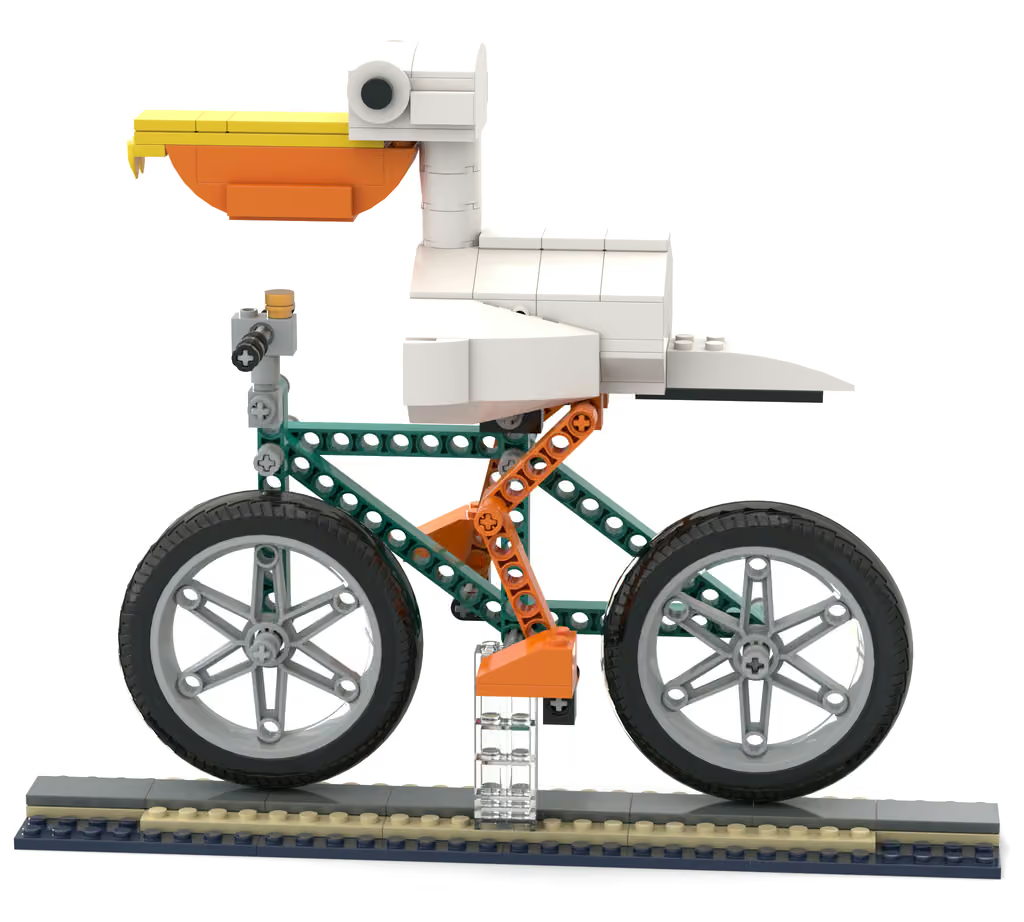
Tests for this kind of work already existed. They put a single object of under 100 parts in front of a model and asked how closely it resembled the description. Two things were missing from that, the authors write. One is scale: a retail set runs from hundreds to thousands of parts, and the available inventory is fixed. The other is design. Making something that works and making something worth making are different problems, and there is no pass-or-fail test for whether a design is any good. Two models can satisfy exactly the same description and be nowhere near each other in quality.
There are 300 tasks, split across three settings. Model covers single constructions of up to 400 parts. Set covers retail-scale builds of 400 to 4,000 parts. Alt-Build asks for a rebuild using only the 783 parts that come in retail set 10698. Each setting holds 100 tasks, spread across ten themes at ten apiece: medieval and castle, vehicles, trains, space, art objects, architecture, plants, animals, pirates and period pieces. Prompts average 45, 57 and 31 words respectively.
Scoring runs on four axes. Valid asks whether the design meets the parts requirement, is free of collisions, and stands up under gravity; stability is confirmed in a PyBullet physics simulation, where components must displace less than 3 LDraw units once gravity is applied. VQA breaks the prompt's requirements into yes-or-no questions, which Gemma 4 31B then scores to produce a satisfaction rate. ELO places two designs side by side, has a vision-language model choose between them, and converts the outcome through a Bradley-Terry model, with separate scores for how well a design matches its prompt (Align ELO) and for design quality independent of the prompt (Design ELO). Cost is the list price of the tokens spent on one design.
The protagonist of this article is BrickAgent, released with the benchmark. The agent can search for parts, place them against connectors, rotate and move and flip them, check dimensions, define subassemblies and merge them, and render the build at any point. And a checker comes attached. It reports where connections have broken, which parts collide with which, and where the structure gives way, pointing at the parts responsible. That is possible because every LDraw part arrives with typed connectors already annotated on it. They come in five kinds (stud, hinge, axle, ball and fixed), which lets the build be handled as a set of connections rather than a set of coordinates.
Each agent gets 300 turns per prompt. Runs went through Codex CLI, with the Claude models driven by Claude Code. The environment's instructions explain the tools with examples, state the parts requirement for the setting, and then add that a skilled LEGO designer will judge this design against others by the standard of published sets.
With the Tools in Hand, Almost Everything Gets Built
Start with the result: an agent holding BrickAgent almost never produces a physically wrong design. Five of the eleven agents tested were judged valid on all 300 tasks.
| Agent | Valid | VQA | ELO | Cost per design |
|---|---|---|---|---|
| GPT-6 Astra | 1.00 | 0.954 | 1297±22 | $4.06 |
| GPT-6.1 Sol | 1.00 | 0.945 | 1293±23 | $0.87 |
| Claude Opus 5.5 | 0.99 | 0.923 | 1249±23 | $6.33 |
| Claude Opus 5 | 1.00 | 0.908 | 1101±17 | $16.47 |
| Qwen 3.8 Flash | 0.90 | 0.852 | 1048±17 | $1.75 |
| GPT-5.6 Sol | 1.00 | 0.859 | 1015±16 | $1.02 |
| Gemini 3.8 Flash | 0.98 | 0.856 | 1014±17 | $3.70 |
| DeepSeek V4.1 Flash | 0.94 | 0.813 | 1006±17 | $0.71 |
| GPT-5.6 Luna | 1.00 | 0.792 | 898±16 | $0.75 |
| Muse Spark 1.3 | 0.80 | 0.718 | 868±20 | $6.68 |
| GLM 5.3 Flash | 0.92 | 0.590 | 752±23 | $0.54 |
Aggregated over all 300 tasks across the three settings. ELO is the overall score combining Align ELO and Design ELO. Source: arXiv:2610.12452, Table 1.
Two places in the table hold the eye. One is the top two rows. GPT-6 Astra's 1297 and GPT-6.1 Sol's 1293 have overlapping error intervals, so the two cannot be told apart, while one design costs $4.06 from the first and $0.87 from the second, a gap of more than four times. Claude Opus 5 is the most expensive at $16.47 and places fourth overall. Score and price do not travel together.
The paper also records where the remaining failures came from. Across the nine agents in the reference set, 137 designs failed to earn a valid verdict, and 44 of those never produced any output at all. The rest fell over under gravity (41), had parts overlapping (31), or missed the parts count the setting required (21). The setting that broke most often is Set, the one asking for 400 to 4,000 parts; the valid rate there drops to 0.68 for Muse Spark 1.3 and 0.79 for Qwen 3.8 Flash. The distribution of part counts shows most agents crowding just above the 400-part floor, which is to say that an instruction to build big returns the smallest scene the setting permits. Astra is the exception, using far more parts than the other agents in both settings.
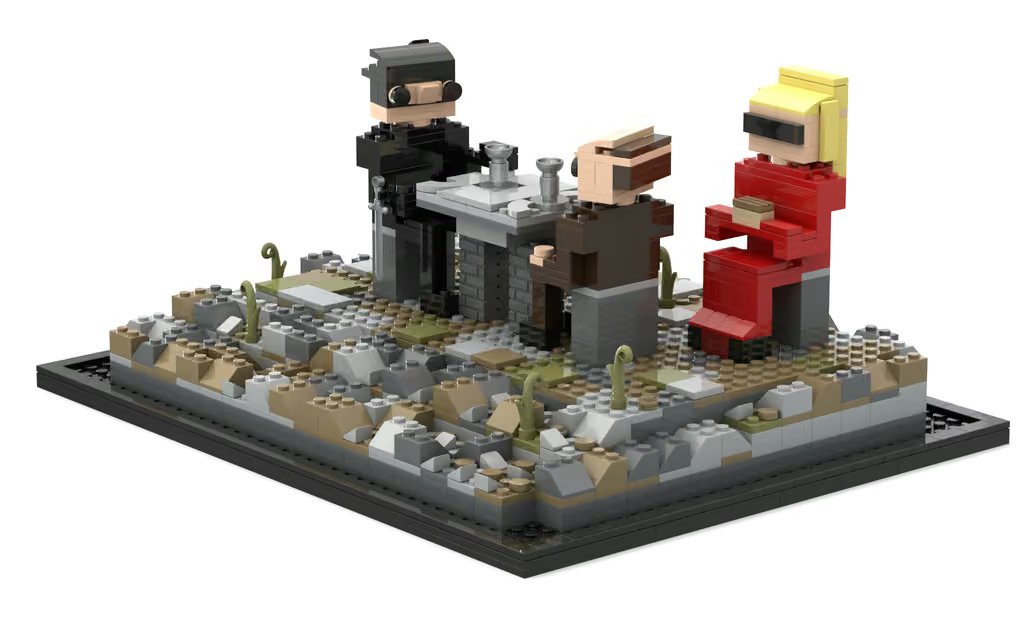
The other place is the gap between the Valid column and the VQA column. GPT-5.6 Luna made all 300 designs buildable and still sits ninth on VQA at 0.792, while Claude Opus 5.5 did not get all of them standing at 0.99 Valid and comes third on VQA at 0.923. Buildability is a constraint the checker answers immediately, so the leaders bunch together. How much of what was asked for actually got built, on the other hand, runs from 0.590 to 0.954, and design quality runs from 753 to 1299 on Design ELO. The models separate on the axis the checker does not report back.
Take the Tools Away and the Same Model Collapses
The authors ran the same 300 tasks past GPT-6 Astra and GPT-5.6 Luna a second time. This round they withheld BrickAgent and handed over only the LDraw parts library and a primer on the file format. Neither the weights nor the tasks changed; the one thing removed was the means of checking a build on the spot.
GPT-6 Astra's valid-design rate went from 1.00 to 0.40. GPT-5.6 Luna was left with one build in 300. Both had scored 1.00 with the environment in place, so this gap opened up inside a single model rather than between two of them.
The shape of the collapse is on record too. Colliding part pairs rose from an average of 0.00 to 7.19 for Astra, and reached 155.51 for Luna. The count of connected components, which measures how many separate pieces a single design breaks into, rose from 2.21 to 6.12 for Astra and from 4.60 to 83.00 for Luna. A scene with several objects standing in it is supposed to come in several pieces, which is why those averages sat between two and five while the environment was in place. Eighty-three is outside that range. Parts that belonged to each other had come away from each other.
What collapsed, though, was buildability and nothing else. Without the environment Astra's VQA slipped from 0.954 to 0.940, about a hundredth, and its overall ELO moved inside the error interval. Luna's scores went up. VQA rose from 0.792 to 0.813 and overall ELO from 898 to 960, a gain of 62 points. Stripped of its checker, Luna produced models that captured the prompt at least as well and looked better, and that could not be built. The authors read this as the buildability constraint limiting expressivity. Turned around, a checker lifts only the axis it checks. That axis is the one that split 1.00 from 0.40, and the others stayed roughly where they were whether the checker was present or not.
One misreading is worth heading off here. Luna is not the second-best model. Its overall ELO of 898 puts it ninth of the eleven. The pair is not first place against second place; it is the model that holds up about halfway without the environment against the one that simply sits down.
The Agents Beat the Specialist Models and Lose to People
Two more entries sit in the paper's version of that table, left out of the one above: BrickNet-14B and BrickGPT, both trained specifically for LEGO generation. Both lose badly to the general coding agents, and they lose in opposite directions, which is what makes them worth reading.
BrickNet-14B scores 0.26 Valid and 0.180 VQA. That 0.26 counts collision-freedom alone. The model does not return designs in a canonical pose, so the direction of gravity cannot be fixed, and the paper notes in a footnote that stability checking was dropped for it. Split the ELO in two and its Design ELO of 952 comes out above general agents such as GLM 5.3 Flash (753) and Muse Spark 1.3 (878), while its Align ELO of 485 is near the bottom of the field. It builds things that look like LEGO, but not the thing it was asked for. BrickGPT occupies the opposite extreme. Its Valid is 1.00, every one of the 300 buildable, and its VQA is 0.024. The paper puts it plainly: "BrickGPT, though valid on each prompt, satisfies 2% of the questions." The fact that buildability alone cannot evaluate a design sits between those two numbers.
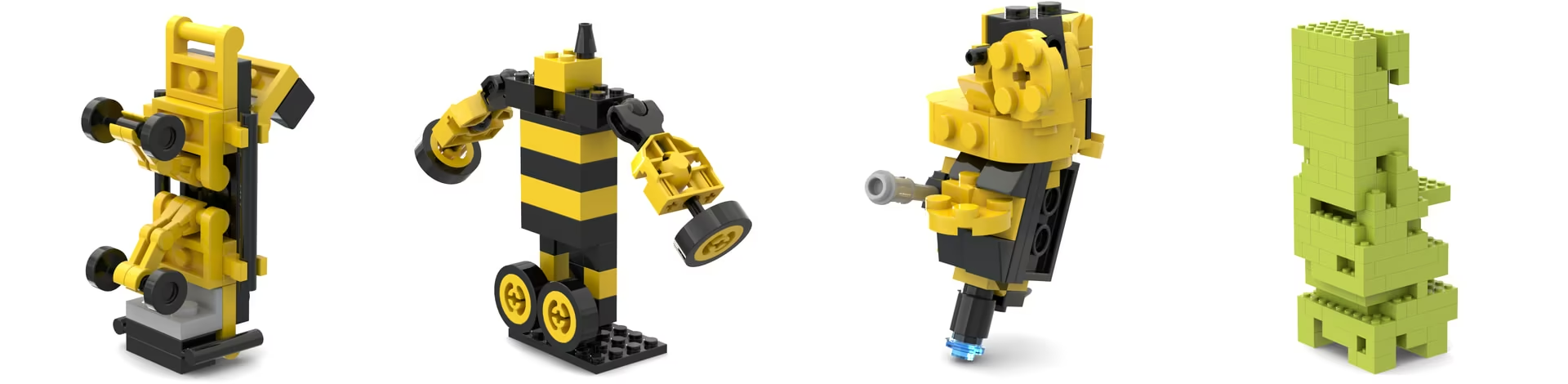
There is an earlier round to this matchup. Before building BrickBench, the authors ran GPT-5.6 Luna on BrickNet's own validation set, the existing test that measures objects of under 100 parts against 512 captions. A general agent never trained on LEGO data beat both BrickNet and BrickGPT on all three metrics there, and came within 0.02 of the human-made ground-truth models on every metric. The older test is effectively saturated, which is the reason the authors went and built a harder one.
This is the first of the four findings the paper draws from its evaluation: data-driven models built for the task are subsumed by general agents, which beat them on their own benchmark and on this one. It points the same way as section 3's conclusion, that the checking tools were what held buildability up. The price runs the other way, though. BrickNet-14B turns out a design for $0.0006 while Astra spends $4.06, and the paper puts the cost of displacing the specialist models at 900 to 6,800 times.
Set the designs against human ones, however, and the story changes. Five evaluators familiar with LEGO were shown an agent design and a human design side by side, matched on part count, and asked which was the human's. They picked correctly 323 times out of 360, about nine in ten. No agent was mistaken for a human more than one time in five: GPT-6 Astra, taken for human most often, managed 4 of its 21 pairs. The human designs in those pairs were drawn from the BrickNet dataset on part count alone, so the subject matter does not match; matching subject would mean commissioning designs, which the authors left for later work.
They also checked whether the design score itself can be trusted. They recruited 102 people on Prolific who judged 40 pairs each, 4,080 judgments in all, and the ranking that produced agreed with the VLM's Design ELO on 34 of 36 agent pairs (Kendall's tau 0.89).
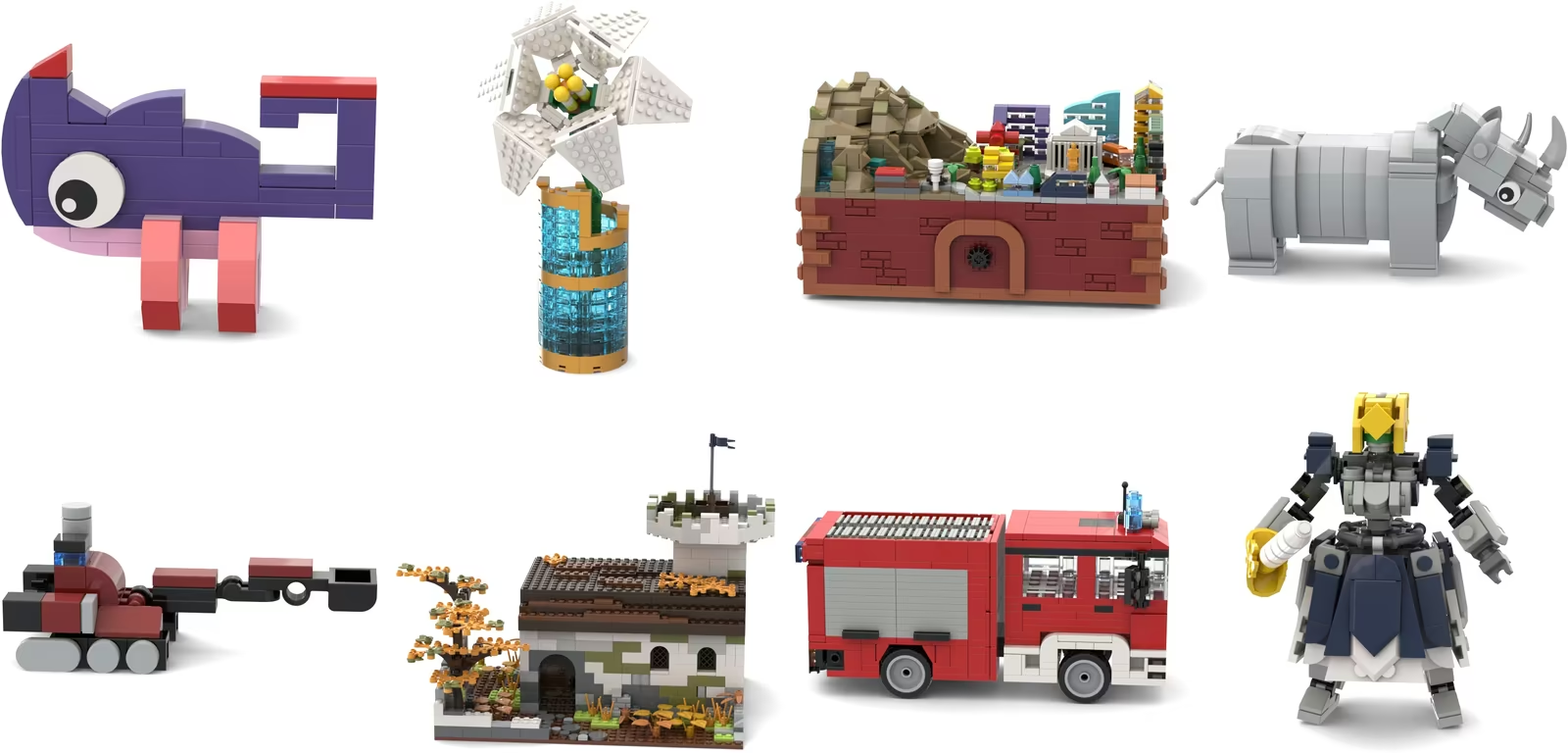
The paper's introduction has a line for this contrast: "Agents are learning to build what works, but not yet what makes a great design." The limitation the authors disclose lives in the same place. Of the stability check they write that "connections are not tested for strength, so an assembly that balances passes even when a physical one might sag or come apart."
Why Pebblous Is Watching This Study
News like this usually gets consumed as "AI designs LEGO now." From where we sit, working with data, a different part of it comes into view first. What separated 1.00 from 0.40 was not model parameters. The weights were the same in both conditions. What differed was whether the agent could look back at its own output in a form a machine could read.
Unpack what BrickAgent's checker returns and it is the answer to three questions. Is this part attached to that one, which parts overlap each other, and where does the structure give way when gravity is applied. None of the three needs a human pair of eyes; each is answered immediately from data. With those answers in hand the agent spends its 300 turns fixing and re-checking. Without them, a model like GPT-5.6 Luna leaves an average of 156 part pairs overlapping and still reports the build as done.
Carry that onto our own ground and one question remains. When we hand work to an agent, are we telling it in machine-readable form whether the work came out right? For a data loading job, schema violations and duplicate keys and referential integrity occupy that position. For labeling, it is contradictions between labels and consistency on edge cases. When checks like these live only in a post-hoc review outside the pipeline, the agent cannot use them. They do what BrickAgent does only when they sit somewhere the agent can call mid-task.
This paper is about LEGO, of course. Connection, collision and gravity are constraints whose right answers are settled by computation, and much of data quality is not like that. Just as agents have yet to learn what makes a good design, no single checker settles what makes good data. Still, the share that computation can settle is a share a checker can hand back, and this experiment wrote down in numbers how much of the score that share was holding up.
Thank you for reading this far. The full paper is at arXiv:2610.12452, and the leaderboard and gallery are at brickben.ch. If your team hands work to an agent and has built machine checks around the result, we would be glad to hear which checks you decided to put in place.
References
R.1Academic
- 1.Kulits, P., Xu, Y., Jones, R. K., Schmid, C., & Wu, J. (2026). "BrickBench: Evaluating Agentic Brick Design." arXiv:2610.12452.
R.2Official Documents
- 2.BrickBench project site. "BrickBench — benchmark description and leaderboard."
- 3.Kulits, P. "BrickAgent." GitHub repository.