Executive Summary
When a company promises a public benefit, the number comes out first and the list of names comes later. The announcement Anthropic published on October 18 followed that order. The share, 5% of the company, was written down as settled. Who would run that money and who would receive it was not written down at all. This article separates what the announcement fixed from what it left blank, and asks what has to exist before the blanks can be filled.
The fund is an LLC wholly owned by Anthropic. With shareholder approval, 5% of company shares move into it, and responding to the labor market impact of AI was named among its uses. Yet who operates the fund, what criteria pick the people who receive money, and what valuation serves as the baseline for adding more equity are all described only as things the company will publish in the next few months.
Sections 1 through 4 follow the facts as written in the announcement and in press coverage. Section 5, which asks what changes when the party paying the money is also the party deciding who counts as harmed, is this article's own reading.
Key Numbers
The first three are the shares this announcement fixed. The last is money Anthropic has committed to the same problem separately from this fund.
Sources: Anthropic (October 18, 2026), TechCrunch (October 18, 2026).
5%
Company shares pledged to the fund
Takes effect only with shareholder approval
2% per 50%
Equity added as the value climbs
Board discretion, each time value rises 50% over a baseline
About 20%
Total equity designated for public benefit
A company figure that adds founder pledges and employee matching
$200M
Committed to labor market impact research
The sum behind an outside research call opened this July
What October 18 Fixed in Numbers
Anthropic posted a piece titled "Investing in the public benefit." It commits 5% of the company's shares to a public benefit fund. The fund is not a separate nonprofit foundation but an LLC wholly owned by Anthropic. The company cited flexibility as its reason for not choosing the tax-advantaged 501(c)(3) form. The share transfer takes effect only with shareholder approval, so what is settled right now is the proposal.
The promise does not end with one transfer. A condition attached to it adds another 2%, at the board's discretion, each time the valuation rises 50% above a baseline. Add the founders' existing pledge to give away 80% of their holdings and an employee matching program, and the company's description puts roughly 20% of equity under a public benefit designation. About half of employees joined the matching, and the shares that would arrive through value milestones are not counted inside that 20%. A clause barring the fund's money from lobbying or political donations, in the United States and abroad, was written alongside.
The scale is not small. The Series H round last May priced the company's last private valuation at $965 billion, which makes 5% worth roughly $48 billion on that basis. The figure moves with whichever valuation you carry into the arithmetic. Using the $1.5 trillion that investors have been discussing ahead of a listing, the same 5% becomes $75 billion. On the skeptical side the spread widens further. The research firm New Constructs put Anthropic at $1.1 trillion in its middle scenario and $144 billion in its most conservative one in an October 6 report. On that last basis, 5% is $7.2 billion.
The valuation used for that arithmetic and the baseline the company says it will measure the extra 2% against are two different numbers. The announcement does not give the second one. So neither what the 5% is worth nor when the 2% arrives can be worked out from outside the company today.
The timing of the announcement reads alongside the numbers. At an investor day held at its San Francisco headquarters on October 14, Anthropic disclosed third-quarter revenue of $16.8 billion. That is 45% above the previous quarter, and set against the second quarter, when revenue doubled, the pace has slowed. Reuters reported the next day that investors who had attended were beginning to talk about a valuation of around $1.5 trillion. The expectation had at one point been $2 trillion. The public benefit fund was announced three days after that, on a Sunday.
CNBC quoted Lise Buyer, an adviser on public offerings, describing the timing as good for burnishing a reputation at a moment when scrutiny of AI has intensified. Buyer also attached a condition, saying the fund would be worth viewing favorably if it goes toward retraining or re-employment. Judgment, in other words, waits on the use. Chief executive Dario Amodei himself presented the announcement as an answer to the crisis of trust the industry has run into.

The Uses Are Written, the Recipients Are Blank
The announcement wrote the spending in two branches. One is large donations to traditional nonprofit organizations. The other is direct distribution to specific populations. The second one stands out, because it means giving money to people without passing through an organization. AI safety and interpretability research and biomedical research sit on the same list.
The group that comes to mind first as a target for direct distribution is people who have lost work because of AI. Anthropic said it has already committed $200 million to studying and addressing labor market impacts, and added that the pace at which AI is advancing may call for bolder approaches. That is the background against which responding to employment shocks landed on this fund.
What that $200 million is deserves a separate look. It is the Economic Futures Research Fund opened this July, a call that hands outside universities, research institutes, and nonprofits large experiments or pilot programs in the range of $5 million to $30 million each. The call's guidance says who may apply. It does not say who reviews the proposals that come in and picks among them. This fund did not invent the blank where a procedure for choosing who gets the money should be.
Three things are undecided. First, what valuation serves as the baseline for adding more equity. Second, who runs the fund and who decides disbursements. Third, what criteria pick the people who receive the money. The announcement says only that these three will be published in the next few months.
There is no need to read the blanks as concealment. Closer to the facts is that they had not been settled when the announcement went out. Still, the third of the three differs in kind from the other two. A baseline is a question of arithmetic and an operator is a question of appointment, but picking the people who receive money requires data before anything else.
The Criticism Aims at the Process, Not the Amount
The reactions that followed the announcement did not take issue with the money. Elon Musk said the shares should be handed to the public directly rather than routed into a separate LLC. David Sacks, formerly the White House AI policy lead, wrote that all anyone can confirm is that 20% went into an LLC, and whether that money actually reaches a public benefit is unknowable. Palmer Luckey, who founded Oculus, asked how far the definition of public benefit would be drawn.
Different in temper, similar in where they point. The complaint is that nobody outside the board looks into the structure. What they are asking is not how much equity was carved off but who decides who owns that money.
There is a place, though, where these criticisms stop. They reach the question of who decides, and they do not ask where the data for that decision comes from. If recipients are chosen one person at a time, the name of the decision maker settles nothing on its own. A list appears only after something has sorted out which job losses are attributable to AI.
In fund design, eligibility criteria are usually the last thing settled. And those criteria are tied less to money than to data. Where there is nothing to sort with, a criterion written as fairly as you like still has no one to apply it to.
Anthropic's Economic Index Cannot Name the Displaced
Anthropic has already turned AI's effect on the labor market into numbers. The Economic Index, published since 2025, maps conversations arriving at the company's own models onto occupational tasks and aggregates how far a given kind of work overlaps with AI use, under a figure it calls observed exposure. It was an attempt to use private logs to track a pace public statistics cannot keep up with, and it has become one of the most frequently cited sources on this subject.
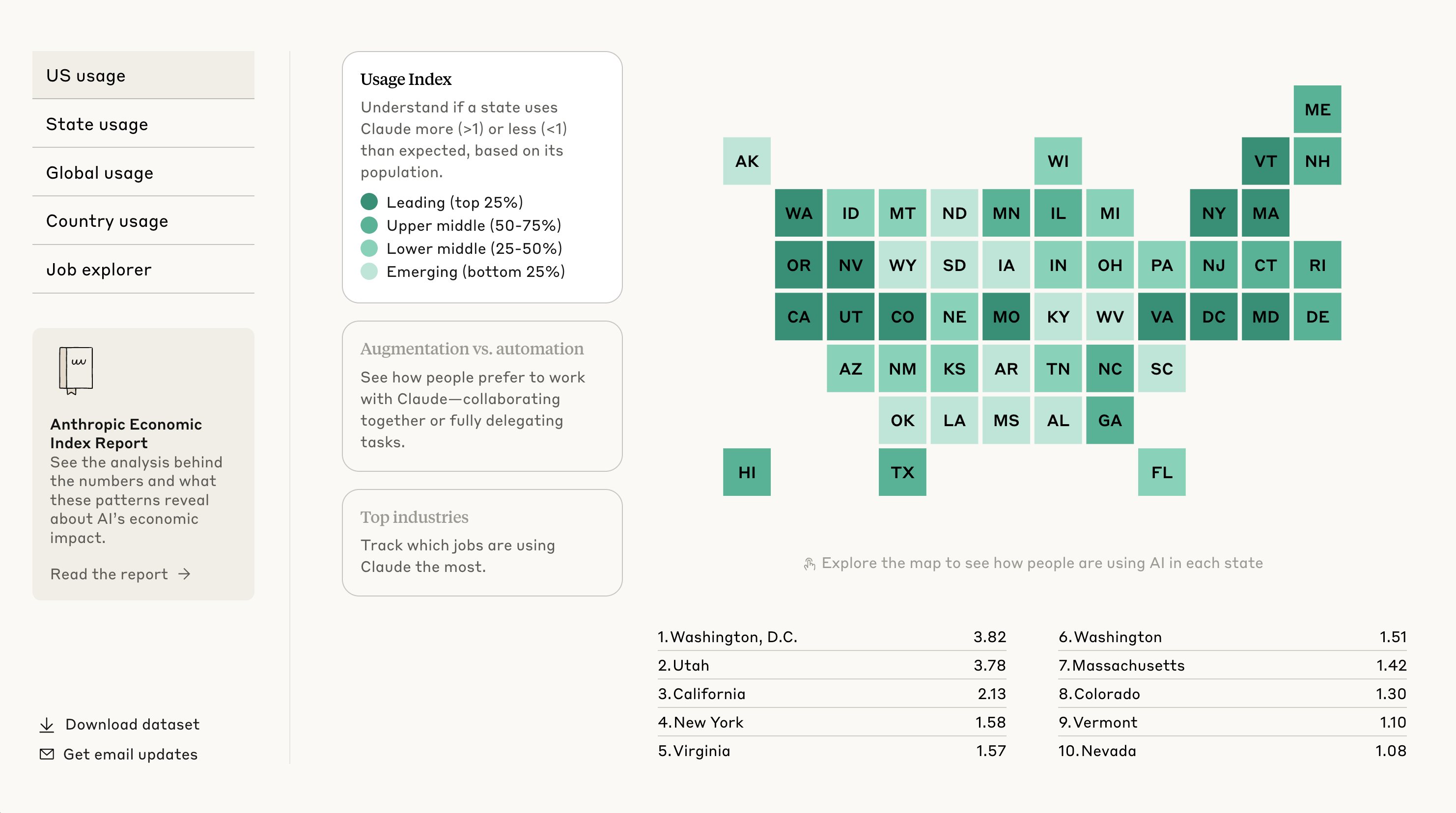
What the index shows is which occupations have tasks that overlap with model use, not who in those occupations lost work or why. Anthropic's own measurement paper, released this March, says the same thing. It found no trace of unemployment rising in the most exposed occupations, and reported instead that the rate at which 22 to 25 year olds find work in those occupations fell by 14%. It then added that even this figure is just barely statistically significant. The Stanford Digital Economy Lab's August revision reported that employment for the same age group had opened a relative gap of 19% against less exposed peers, and there too the gap ran through hiring rather than separations.
Outside criticism goes a step further. Hamilton Mann's commentary in Forbes warned that the index should not be read as evidence of who is at risk of being displaced by AI. The data holding the index up is conversations with Claude and nothing else, so the index reflects Anthropic's user base rather than the economy. Offices also run other companies' models and other automation tools. Mann's reading is that exposure marks where work changes first, not where jobs disappear first.
Put it together and it comes to this. Even the most systematic measurement tool in existence today cannot, on its own, write the sentence "this person lost a job because of AI." And the change captured most clearly so far is not separations but reduced hiring. A person who was never hired does not enter an unemployment register. There is no line for them on a company's reason-for-termination field or on a benefits claim. For the fund to pick people and give them money, data that can write that sentence has to be built somewhere new.
Why Pebblous Is Watching This Fund
The moment the fund chooses to put money into people's hands directly, Anthropic stands in two places at once. The place that pays, and the place that sorts out who counts as harmed. The party holding the data to do that sorting is, for now, also Anthropic. An index the company compiled from conversations arriving at its own models is the densest source available on this subject.
Nor does the problem dissolve if the index goes unused. Public employment statistics move in quarters and occupational categories and cannot descend to one person's reason for losing work, and private layoff trackers only count the cases where a company wrote AI in that field. Neither can attribute a single person's job loss to AI. That the alternatives are poor does not erase the conflict of interest.
So the few months of deferral is hard to read as bureaucratic delay alone. Of the three things held back, eligibility criteria are not the sort of problem that resolves by adding staff. Writing a criterion requires data to apply it to, and that data does not yet exist.
From where data work sits, the shape is familiar. When the party that builds the measure is the same party whose gains and losses ride on it, a correct result is still hard to believe. It is the same reason teams avoid a structure where the group that designed a quality metric is assessed by that metric. The fund's precondition is data rather than money, and data's precondition is whether eyes outside the builder are checking it.
In the document still to come, three things rather than the amount are worth checking.
- • The provenance of the data used to decide. Does it say which data sorts recipients, who collects that data, and where it is held? If the company's own index is used, saying so is the starting point
- • A verifier outside the company. Who outside Anthropic can look at a decision again? Even if someone is looking, without access to the underlying data the verification is only a notice of results
- • A channel for those left out. Is there a procedure for someone excluded to contest the decision? Without a channel for appeals, there is also no way to learn that a criterion was wrong
Until those three are filled, the figure of about 20% is the size of a promise rather than the size of a disbursement. And none of the three fills by putting in more money.
Editor's Note
Giving pledges are remembered as amounts and forgotten as disbursements. If this announcement differs in anything, it is in saying first that it intends to identify the people who will receive the money. Money given to an organization ends in a receipt; money given to people leaves a list. What that list gets built from will be the real length of the document a few months from now.
Thank you for reading this far. The facts here were checked against Anthropic's announcement and reporting from TechCrunch and CNBC, and the assessment of the economic index comes from the index's published documentation, Anthropic's own measurement paper, and the Forbes commentary. When the fund's structure and eligibility criteria are published, we will cover them separately. If you have a case of how your organization recorded the workforce effects of adopting AI, and with what data, we would be glad to hear it.
Pebblous Data Communication Team
October 20, 2026
References
- 1.Anthropic. (2026). "Investing in the public benefit." Anthropic News, October 18, 2026. The 5% transfer, the 2% added on value milestones, the roughly 20% designation, and the lobbying and political donation clause — primary source for Sections 1 and 2.
- 2.TechCrunch. (2026). "Anthropic says it's committing 5% of its shares to a public benefit fund." TechCrunch, October 18, 2026. Confirmation of the announced figures, the public benefit corporation structure, and the crisis of trust remark — source for Sections 1 and 2.
- 3.CNBC. (2026). "Anthropic commits 5% of shares to public benefit fund." CNBC, October 18, 2026. The LLC structure and the reason for not taking 501(c)(3) status, third-quarter revenue and listing timing, and the Lise Buyer comment — source for Section 1.
- 4.Anthropic. "Anthropic Economic Index." How observed exposure is computed and how employment trends are read — source for Section 4.
- 5.Massenkoff, M., & McCrory, P. (2026). "Labor market impacts of AI: A new measure and early evidence." Anthropic Research, March 5, 2026. No unemployment effect in highly exposed occupations, the 14% fall in the job finding rate for ages 22 to 25, and the statistical caveat on it — source for Section 4 and the FAQ.
- 6.Mann, H. (2026). "Anthropic's Study Does Not Measure AI's Labor-Market Impacts." Forbes, March 8, 2026. The point that the data is Claude usage alone, and how exposure should be read — source for Section 4.
- 7.Brynjolfsson, E., Chandar, B., & Chen, R. (2026). "Canaries in the Coal Mine? Six Facts about the Recent Employment Effects of Artificial Intelligence." Stanford Digital Economy Lab, August 2026 revision. The 19% relative employment gap for ages 22 to 25 and the finding that it runs through hiring — source for Section 4.
- 8.Anthropic. (2026). "Economic Futures Research Fund: research agenda." July 22, 2026. Eligibility for the $200 million call and the $5 million to $30 million range per project — source for Section 2.
- 9.Reuters. (2026). "Anthropic IPO valuation expectations cool as revenue growth slows." October 15–16, 2026 (Yahoo Finance mirror). The October 14 investor day, third-quarter revenue of $16.8 billion and the 45% increase, and the $1.5 trillion and $2 trillion figures — source for Section 1.
- 10.The Next Web. (2026). "Research firm calls Anthropic the 'most ridiculous IPO of 2026', says it may be worth $144bn." Scenario valuations from the New Constructs report of October 6, 2026 — source for Section 1.