Executive Summary
This article reads the two AI devices Amazon showed on 15 October through one question, which is where the data ends up. The Bee Frontier, worn on the wrist or clipped to clothing, is $74.99. The Bee Eclipse, a credit-card sized unit that attaches magnetically to the back of a phone, starts at $99.99. They are the first products to come out since Amazon bought the startup Bee in 2025.
The promise both devices lead with is that no raw audio is kept. What the microphones pick up is turned into insights in real time and then deleted on the spot, and nothing is stored separately, as Amazon puts it. Something else sits outside that deletion. The transcripts of those conversations, and the summaries built from them. Of the two it is the transcript that Amazon says stays encrypted, under keys the device alone creates and controls. Free users keep 14 days of memory, and Bee Pro at $11.99 a month lifts that limit.
Everything to this point is written in Amazon's announcement and in TechCrunch's report. The later part of Section 4 and Section 5, where the price list and the integration list are read as a signal that the priced asset is the text, is this article's own interpretation.
Key numbers
Four cells. The first two are what the hardware costs. The second two are the value placed on the text those devices produce, and how far that text travels.
Sources: Amazon's official announcement, TechCrunch (15 Oct 2026).
$74.99
What Bee Frontier costs
A wearable for the wrist or a collar. It undercuts both rivals TechCrunch lined up against it, the Pocket AI ($129) and the Plaud Note ($159, or $189 for the Note Pro)
21+ days
Bee Eclipse battery life
A credit-card sized unit that sits on the back of a phone, from $99.99. The Frontier on the wrist runs up to 7 days, so the one you stick on and forget is the Eclipse
14 days
What a free user keeps
Without a subscription the transcripts and summaries pile up for 14 days only. That window is exactly what Bee Pro at $11.99 a month unlocks
Seven
Integrations Amazon named
Gmail, Google Calendar, Outlook, Apple HealthKit, phone photos, Alexa+, Amazon.com. Once the audio is gone, the written record still moves through these channels
Bee Frontier on the Wrist, Bee Eclipse on the Phone
Amazon acquired Bee, an AI wearable startup, in 2025. The Bee Frontier and the Bee Eclipse unveiled on 15 October are the first products since that deal. Both do the same job. They listen to the talk going on around you through the day and hand it back as summaries and to-do lists. What differs is where they sit on the body.
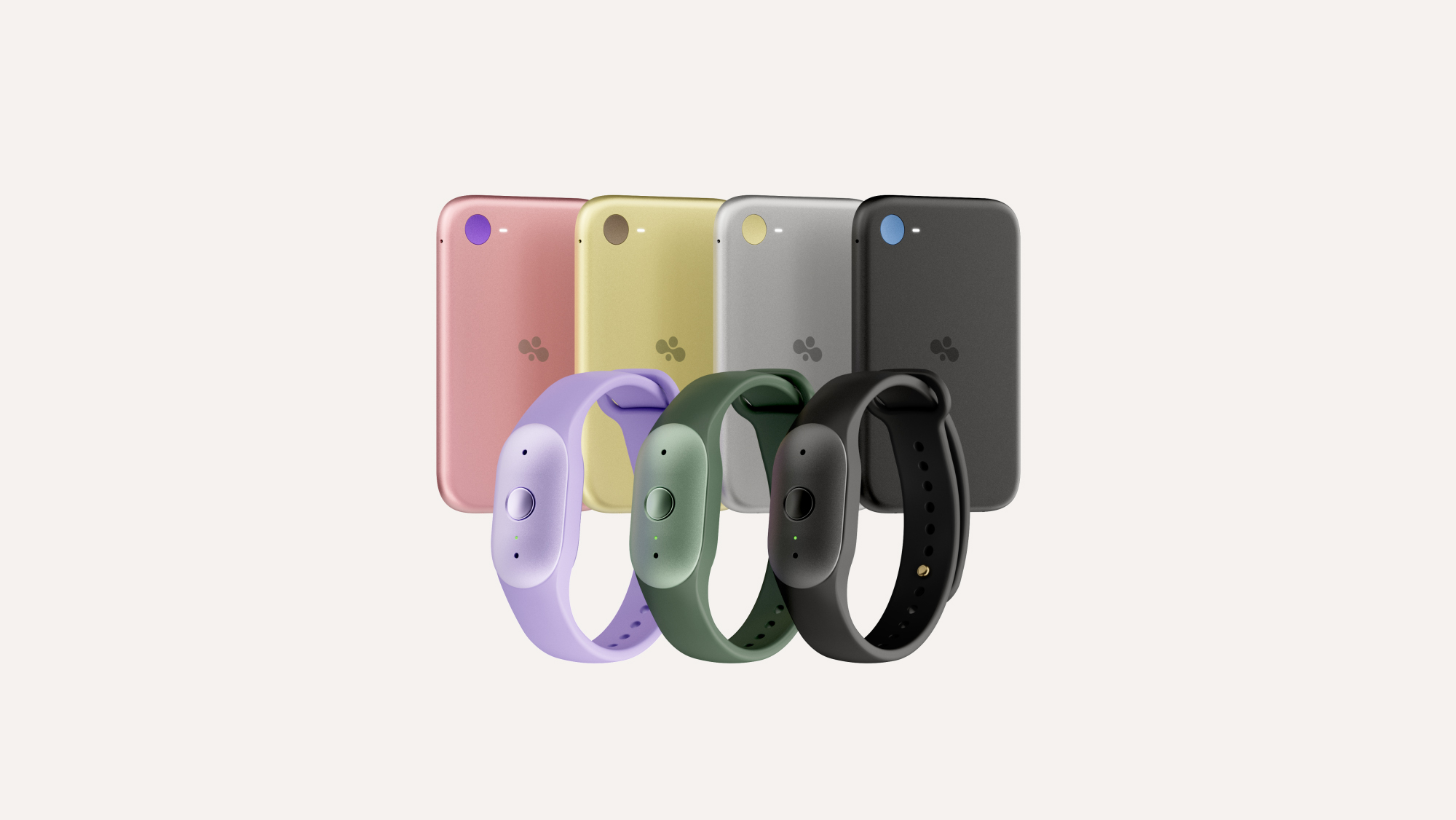
The Bee Frontier is a $74.99 device you wear on the wrist or clip to your clothes. It comes in Onyx, Lavender and Sage, and carries an IP67 water resistance rating. The battery runs up to 7 days and charges over USB-C. Two microphones filter out noise, and the only things on the outside are a single button and an LED that tells you whether the device is on. It is on sale now.
The Bee Eclipse is a slim credit-card sized attachment that snaps magnetically onto the back of a phone, starting at $99.99. Silver, Midnight, Honey and Blush are the colors. The battery running 21 days or more is the sharpest difference from the Frontier. A release date has not been announced.
Put price, placement and battery side by side and the two devices split into different uses. One goes on the wrist and gets charged every week, and the other goes on the back of a phone and can be forgotten for three. The table below pulls out only the published specifications that bear on that choice.
| Item | Bee Frontier | Bee Eclipse |
|---|---|---|
| Price | $74.99 | From $99.99 |
| Worn | On the wrist or clipped to clothing | Magnetically on the back of a phone |
| Battery | Up to 7 days, USB-C charging | 21 days or more |
| Colors | Onyx, Lavender, Sage | Silver, Midnight, Honey, Blush |
| Availability | On sale now | Coming soon |
The price shows which slot Amazon went after. The products TechCrunch set beside it are the Pocket AI at $129 and the Plaud Note at $159, with the Note Pro at $189. Amazon cut in underneath. For a device meant to stay on all day, the first thing the company lowered is the price that makes a buyer hesitate.
What Gets Deleted When Amazon Says Deleted
Selling a device that is always listening means explaining first what happens after it listens. The name Amazon put at the front of this launch is Bee Private Compute. Conversations are handled inside a secure, isolated processing environment, and no one, Amazon included, can reach a user's data. That is the company's description.
Within that structure, what happens to the raw audio is stated plainly. Sound picked up by the microphones is turned into insights in real time and deleted immediately afterwards. The raw audio is not stored, Amazon wrote. Start recording a phone call and a prompt appears telling you to ask the other party for consent, and the device itself carries one power button and an LED showing whether it is running. The design lets anyone outside the wearer see whether it is on.
Read that far and the privacy question looks settled. If no recording survives, there is no audio to leak. That sentence is doing promotional work in this launch, and it leads whenever the product is set apart from its competitors. The subject of the promise, though, is raw audio all the way through. It says nothing about anything that is not audio.
What Stays Is the Written Record
The same announcement also lists what is kept. Transcripts of the conversations, and summaries. The sentence about encryption, though, attaches to only one of those two. Transcripts are encrypted with keys that only the device creates and controls, Amazon wrote, which means nobody else, Amazon's own employees included, can open those files unless the user deliberately shares them. No such sentence was written for the summaries. Deletion is left open on both. Users can delete their transcripts and summaries at any time, the notice says.
A notice offering deletion at any time tells you something in reverse. It tells you there is something to delete. No such notice attaches to the audio, because the audio is already gone. The boundary between an original and a derivative is drawn right between the data that needs a delete button and the data that does not.
Break the handling of a single spoken sentence into steps and two paths appear. One ends at deletion, and the other begins there.
Staying on as ciphertext and not existing are two different states. Encryption decides who holds the key, and it does not make data go away. If the account of the key living on the device is accurate, then the only party who can read those transcripts right now is the user. The transcripts are still there all the same. What has accumulated is an asset whose status can change the moment a key is moved or copied.
One more thing is worth stating plainly. The claim that nobody can get access is a company account that no outside audit has tested, and several outlets have pointed at the same spot. The structurally checkable part is the statement that raw audio is not stored. Whether an encrypted derivative is truly beyond everyone's reach is something a reader currently has no way to verify, short of taking the company at its word.
Deletion and retention are written in the same paragraph, but they attach to different things. Deletion attaches to the audio, retention to the text. When a promotional line gets shortened and only the first half survives, a reader comes away thinking the whole conversation disappears. What disappears is the voice. What that voice said becomes writing and stays.
Money Buys a Longer Memory
Which data matters to a company is usually visible in its price list. Bee's free tier gives conversation summaries and recaps, and holds 14 days of memory. Bee Pro, at $11.99 a month with 30 days free for new subscribers, opens the following.
- • Recent summaries and daily memories that accumulate with no time limit
- • Suggested to-dos and conversation templates
- • A personal chat assistant that can be asked about the stored record, plus a desktop app
- • Integration with Amazon.com and Alexa+, along with third-party apps
Run down the list and the object of the charge comes into view. Audio is deleted the same way for a free user and for a Pro user. What separates the two tiers is how long the written record is held, and which channels reach it. The price is attached to the retention window of the text and the means of getting at it.
The integration list spells those channels out. Gmail, Google Calendar, Microsoft Outlook, Apple HealthKit for health data, phone photos to attach to the day's record, Alexa+ and Amazon.com are the names Amazon gave. Mail and calendar pull tasks out, while HealthKit and photos fill out the daily record. Pair the device with Alexa and an Echo recognizes the user by voice ID and serves up the insights Bee produced. That feature is opt-in.
Integrations lengthen the life of the text. The written record becomes something to search, an input for suggesting tasks against a calendar and a mailbox, and the basis on which another device recognizes a person. None of that works on a single block of raw audio, and all of it works on structured text. A design that deletes the voice and a design that makes the text useful are not pulling against each other. They point the same way.
From here on, this is this article's reading. Throwing away raw audio is a privacy measure, and it is also an operationally sensible choice. Audio is heavy, hard to search and expensive to store. Keeping only text, which is light and searchable and connectable, costs less and does more. Leave out the fact that the two reasons converged on one design, and the deletion promise reads as a bigger concession than it is.
Why Pebblous Is Watching Bee's Deletion Promise
Few words cause more confusion inside a data team than a report that something was deleted. Whether the original file went, or whether the features and indexes and caches built from it went too, hides inside the same word. Bee's announcement is on the more candid end of that spectrum. It says the audio is deleted, and it says separately that the transcripts are kept under encryption. The two sentences sit in the same place, and when the message travels outward only the first one survives.
Preparing data that AI can use includes managing the life cycle of derivatives on their own terms. Even when the original is gone, a derivative demands its own retention period, its own access rights and its own deletion procedure. The derivative is in fact the side that gets used longer. What a model trains on, what a search index covers and what another service picks up is mostly not the original but the cleaned-up text. When the deletion policy applies only to the original, the part that lasts longest and travels furthest is left with no policy at all.
Recording the conditions of collection alongside the data is the other problem that comes with it. One strand of the criticism around Bee runs on a different axis from this article's argument. The wearer consented, the point goes, but the person talking beside them never did. The comparison sometimes drawn is with the Limitless Pendant, which sounded a chime to announce that recording had begun. That product stopped selling to new customers when Meta acquired it in December 2025, and its design of signaling consent out loud still gets called up as a benchmark. Under the wiretapping laws of US states that require both parties to agree, the point has also been raised as a legal risk. That is a question about the lawfulness of recording itself, which is separate from the distinction between deletion and retention, though from the data side the two meet in one place. Speech whose consent status was never written down becomes text and gets stored.
Conditions not recorded at the moment of collection cannot be reconstructed later. If nothing beside a transcript says which conversation was captured under whose consent, that text becomes an asset whose usability is in doubt before its quality is even discussed. Eligibility has to be settled before quality. Given how much a $74.99 device produces in a single day, the question does not stay a matter of individual choice.
Thank you for reading this far. Amazon's full announcement is at the Amazon newsroom, and the report covering specifications and prices is at TechCrunch. When your team writes that something was deleted, what is the subject of that sentence, the original or the derivative? We would like to hear how you answer it.
References
- 1.Amazon. (2026). "Amazon introduces Bee Frontier and Bee Eclipse." About Amazon, 15 October 2026.
- 2.TechCrunch. (2026). "Amazon's Bee launches two new personal AI devices starting at $75." 15 October 2026.
- 3.TechCrunch. (2025). "Meta acquires AI device startup Limitless." 5 December 2025. (basis for the Limitless Pendant sales halt noted in Section 5)