Executive Summary
Andreessen Horowitz, a firm that built its name on software, closed a fund on August 28, 2026 that buys hardware and nothing else. It holds $1.1 billion and it is called the Machine Age Fund. The scope runs from compute infrastructure such as chips, memory, networking, and storage to the finished systems that run AI: data centers, robotics, and home AI appliances.
The number the firm leads with is power. A rack used to draw roughly 5 to 10 kilowatts, it now draws 100 to 250 kilowatts to support today's systems, and a16z expects it to reach 1MW over the next three years. The hardware supply side is used to growing 20% to 30% a year at most, while demand asks for triple digits. The firm argues that today's supply chain cannot close that gap on its own.
What is missing is data. The word itself appears four times in the post, and all four times it means data center. Robots and edge devices are described only as the things AI needs in order to reach the world outside, and there is not one sentence about the record those machines will pile up second by second.
Key Numbers
The first three numbers are the ones the announcement rests on. The fourth comes from the side the announcement leaves alone. Capital and power are counted in billions and megawatts, while the record those machines leave behind is still counted in hours.
Sources: a16z, The Machine Age Fund (2026-08-28) · Khazatsky et al. (2024), DROID
$1.1B
Size of the Machine Age Fund
a16z's first venture fund dedicated to hardware
1MW
Power per rack in three years
Up from 5 to 10kW, now passing 100 to 250kW
28X
Rise in compute density per rack
From an H100 rack to a Rubin rack
350 hours
All of DROID's manipulation data
Open dataset gathered by 50 collectors on three continents over 12 months
Occasional Deals Became a Standing Practice
The first sentence of the post a16z published on August 28 is that it raised $1.1 billion. The firm wrote that the money goes into all of the computer infrastructure on which AI runs. Chips, memory, networking, and storage make up one bundle. The finished systems that actually run AI make up another, and that second bundle puts data centers, robotics, and home AI appliances side by side. Five partners signed the post: Ben Horowitz, Martin Casado, Raghu Raghuram, David Ulevitch, and David George.

a16z has stood on the other side of this line for a long time. Fifteen years have passed since Marc Andreessen wrote that software is eating the world, and in that stretch the firm's reputation came from a software playbook that is cheap on capital and fast on iteration. It is not that hardware went untouched. a16z led Skydio's Series A in 2016, invested in SpaceX, wrote its first check into Anduril in 2019, and was among the first venture investors in Waymo's 2020 raise. In Martin Casado's words, though, "it was never a main focus."
What changed sits on the founder side. The post says that over the last couple of years hardware startups grew from a small amount of the firm's deal flow to over 20% of it. The hardware companies it names as recent backings are Unconventional AI, Nexthop, Volta, Atoms, Heron Power, and Mind Robotics. The team is introduced along the same line. Guido Appenzeller was the CTO for Intel's Data Center Group. Raghuram and Casado spent multiple decades in the data center space with system software, much of which required deep hardware partnership. Shangda Xu and David George have led investments across the AI infrastructure stack, from silicon and networking to large-scale systems and compute platforms. David Ulevitch and Erin Price-Wright already lead many of the firm's hardware and U.S. manufacturing investments through its American Dynamism practice.
The phrase the firm chose for itself is that it is making hardware an official motion for a16z. What used to happen now and then through individual deals now has dedicated money and dedicated people behind it. Money is not the only thing the post counts as part of that promotion. The go-to-market, talent, and marketing machine the firm built is now ready to serve hardware founders, and the network that reaches customers and suppliers comes with it. Raghu Raghuram described the fund's range as "things that are within the four walls of the data center."
One Rack Will Draw a Megawatt
Asked why now, the post answers with a lag between demand and supply. As AI moves from chat to reasoning and on to coding and other forms of knowledge work, both the demand for work and the token intensity of that work rise by orders of magnitude. The hardware supply side, meanwhile, is an industry tuned to 20% to 30% growth a year at most. The firm reads that gap as every layer of the stack hitting the wall of today's supply chain capability, and the limits of physics and computer science.
Rebuilding the bottom layer is not new, and the post says so. The shift from mainframe to client server, and then to the Internet, cloud, and mobile, rebuilt the floor of computing each time. What is different now, it argues, is the magnitude and breadth of the change needed to keep up with demand, and the speed required to do it. Martin Casado put it this way to Dealroom: "Every time we have one of these technical epochs, it puts pressure on the infrastructure, but none of us have ever seen it this dramatic." So the firm calls this a once-in-a-generation opportunity, and it draws the boundary of what gets redesigned all the way down to the electricity.
Power shows the size of that gap most plainly. A rack used to draw roughly 5 to 10 kilowatts. It moved to 100 to 250 kilowatts to support today's systems, and the post expects 1MW over the next three years. On another line of the same list, compute density per rack increased 28X from an H100 rack to a Rubin rack, and networking within a rack has grown similarly, hitting the limits of copper cabling. Data center scale itself is moving from tens to hundreds of megawatts, and in some cases to GW-scale campuses.
Once power climbs that far, the problem stops ending at the chip. The list of what the post says is needed holds faster and more efficient systems, cheaper and higher-bandwidth memory across the memory hierarchy, and faster and more scalable interconnects between nodes and systems. Behind that come the cooling, materials, electrical work, and real estate build out to support them. Where the power comes from changes too. The post observes a move from grid-only supply toward the grid plus behind-the-meter or captive sources.
Exactly one line in that list points outside the data center. It is the sentence saying that AI needs power efficient edge devices to explore and interact with the world. That is where robotics and home AI appliances enter the fund's scope.
Capital Has Already Reached the Robots
As themed funds go, $1.1 billion is on the large side, but inside a16z it is a small slice. The firm holds more than $100 billion in assets, and in January alone it raised over $15 billion across several funds, including $6.75 billion for late-stage deals. The weight of this fund sits in its direction rather than its size. A house that stood for software has named the physical layer as the beat of a dedicated team, and that alone is the signal.
a16z is not the only money headed that way. Crunchbase counted $18.8 billion raised by robotics startups worldwide in 2026 as of late June. With more than six months of fundraising still left at that point, the total had already passed the $15 billion raised across all of 2025 and the $14.1 billion raised in 2021, the peak year for venture funding. Narrow the frame to humanoids and Dealroom's chart puts $8.7 billion into the sector year to date, already double 2025's full-year record. Per PitchBook, semiconductor and autonomous-machine startups have raised roughly $100 billion over the past year.
One of the portfolio names a16z wrote into the post sits directly in that current. Mind Robotics, a Rivian spinout, closed a $500 million Series A in March co-led by Accel and Andreessen Horowitz, then took another $400 million in May in a round led by Kleiner Perkins. The company is building an AI-enabled industrial robotics platform aimed at automating industrial and manufacturing tasks at scale. A robot company that absorbed $900 million in two rounds in one year is now a neighbor inside a hardware-only fund.
A pace like this draws the word bubble. Casado dismissed it, saying that while some valuations may fall, overall demand remains strong. Events this year give that argument something to stand on. Cerebras went public in May, and Groq licensed its technology to Nvidia in a $20 billion deal. Companies that make chips are starting to be priced outside the venture round as well.
The Word Data Appears Four Times
Count the word data in the body of the post and you get four. The data centers listed among the investment targets, the data center scale on the line after rack power, Intel's Data Center Group in Guido Appenzeller's résumé, and the data center space where Raghuram and Casado spent their decades. All four point at buildings, power, and real estate. The data center as an asset is present. Data as a record is not.
That is not a flaw. What the fund said it would buy is chips and power and machines, not datasets, so the post simply drew its own boundary accurately. Something does stay outside that boundary, though. Edge devices and robots are machines that run models and machines that pile up sensor records at the same time. Joint angles, gripper pressure, camera frames, and failed attempts pour out for as long as a unit keeps moving. The post explains those devices only as what lets AI explore and interact with the world, and says nothing about what that interaction leaves behind.
The size of public datasets gives a sense of where that record stands today. DROID, widely used in robot manipulation, holds 76k demonstration trajectories, or 350 hours of interaction data. It was collected across 564 scenes and 84 tasks by 50 data collectors in North America, Asia, and Europe over the course of 12 months. Open X-Embodiment, an attempt to pool data across institutions, assembles a dataset from 22 different robots collected through a collaboration between 21 institutions, demonstrating 527 skills. That is a scale one company found hard to reach alone, which is why the institutions pooled their work.
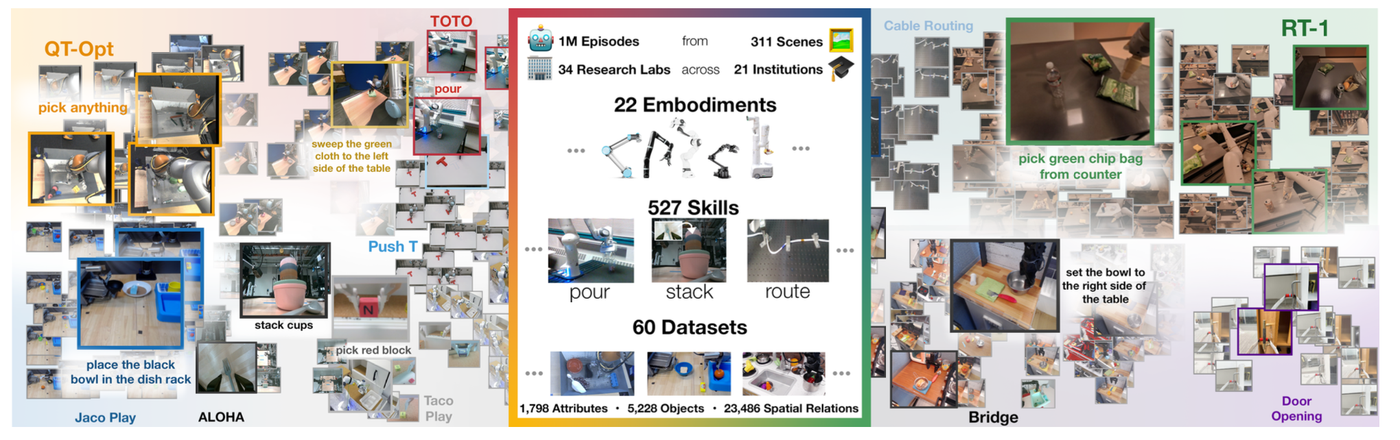
The shape of that gap is written into the problem statements those two papers set for themselves. The DROID authors note that "even the most general robot manipulation policies today are mostly trained on data collected in a small number of environments with limited scene and task diversity," and they name the causes plainly: collecting robot manipulation data in diverse environments "poses logistical and safety challenges and requires substantial investments in hardware and human labour." Open X-Embodiment took hold of the format instead. Conventionally, the authors write, robotic learning methods "train a separate model for every application, every robot, and even every environment," so the team began by putting many institutions' data into "standardized data formats." The point of that work is a question: the consolidation of pretrained models that already happened in NLP and computer vision, can it happen in robotics too?
Money into the physical layer reached $18.8 billion for robotics through June alone. The open record of what that layer does is counted in hundreds of hours. Next to language models that grew on internet-scale corpora, the floor robots stand on is still thin. Hardware can be bought and is being bought, and yet no dedicated fund has attached itself to deciding the format, the ownership, and the quality of the records that hardware will produce.
The case this blog covered earlier in humanoid capital and tactile data shows the same gap one layer down, at the sensor. Billions went into the bodies and the brains, while the data holding fingertip pressure and slip drew capital measured in millions. The Machine Age Fund repeats that structure a level up. Racks and power and robots are getting priced, and the records they will hand back are not.
A decision to invest in edge devices eventually leads to the question of who holds the data those devices make, and in what format. That the post has not opened that question yet does not mean the answer is settled. It means the space where the answer goes is still empty.
Editor's Note
Put one robot on a site for a day and the records accumulate on their own. The questions are whether those records are in a shape you can train on, how much of them the customer owns, and whether failed attempts survive instead of being wiped. Those three are exactly what Pebblous keeps running into when it talks about AI-Ready Data.
References
Academic Papers
- 1.Khazatsky, A., Pertsch, K., Nair, S. et al. (2024). "DROID: A Large-Scale In-The-Wild Robot Manipulation Dataset." arXiv:2403.12945.
- 2.Open X-Embodiment Collaboration. (2023). "Open X-Embodiment: Robotic Learning Datasets and RT-X Models." arXiv:2310.08864.
Industry & News Sources
- 3.Horowitz, B., Casado, M., Raghuram, R., Ulevitch, D., George, D. (2026). "The Machine Age Fund." a16z.com, Aug. 28, 2026.
- 4.Dealroom News. (2026). "a16z raises $1.1B for Machine Age fund to build AI hardware." Aug. 28, 2026.
- 5.Azevedo, M. A. (2026). "Sector Snapshot: Robotics Startups On Fire As Venture Funding Surges To Record Numbers In 2026." Crunchbase News, Jun. 22, 2026.